Best Dog Car: How to Choose the Right Ride
In this article
A lot of dog owners are staring at the same problem right now. There's a dog that needs to ride safely, a vehicle that may or may not fit the setup, and a search result full of “best dog car” lists that mostly shuffle products around without helping with the decision.
That's the wrong way to buy for a dog.
The best dog car isn't a universal vehicle, and it isn't a prestige trim with a pet package. It's the vehicle and restraint combination that fits the dog's body, the cabin's geometry, and the length of the trip. A small terrier on school-run errands needs a different setup than a tall retriever on an interstate move. Treating those as the same shopping problem is how people end up with a giant SUV and a bad restraint, or a decent harness clipped into a terrible seat position.
Here's the clean version. Pick the restraint first, based on real crash-test criteria. Then pick the vehicle layout that lets that restraint work the way it was tested.
| Decision factor | What matters most | Best default choice | Bad shortcut to avoid |
|---|---|---|---|
| Dog size | Weight, height, chest depth, turning room | Match restraint to body size first | Buying by breed label alone |
| Vehicle geometry | Rear seat shape, cargo floor, door height, tie-down points | Choose the body style that supports the restraint | Assuming “bigger car” automatically means safer |
| Trip length | Errands, road trips, relocations | Increase containment and monitoring as trips get longer | Using the same setup for every drive |
| Safety proof | Independent testing details | Look for named test method and pass criteria | Trusting “crash-tested” on packaging |
Table of Contents
- What the Best Dog Car Decision Actually Is
- The Crash-Test Criteria That Decide It
- Matching Vehicle Type to Your Dog
- Fitting the Restraint to Dog Size and Breed
- Everyday Trips Versus Long-Distance Moves
- When a Verified Driver Beats Driving Yourself
- A One-Page Decision Rule for 2026
What the Best Dog Car Decision Actually Is
The best dog car decision is a three-part matching problem. Dog. Vehicle. Trip.
Most buyers start backward. They shop for a vehicle first, then try to wedge a restraint into whatever rear seat or cargo space they bought. That's how large dogs end up half-standing on sloped cargo floors and small dogs end up in flimsy boosters with too much movement.
A better order is simple:
- Class the dog correctly
- Choose the restraint type
- Make sure the vehicle geometry supports it
- Set trip rules for climate, entry, and monitoring
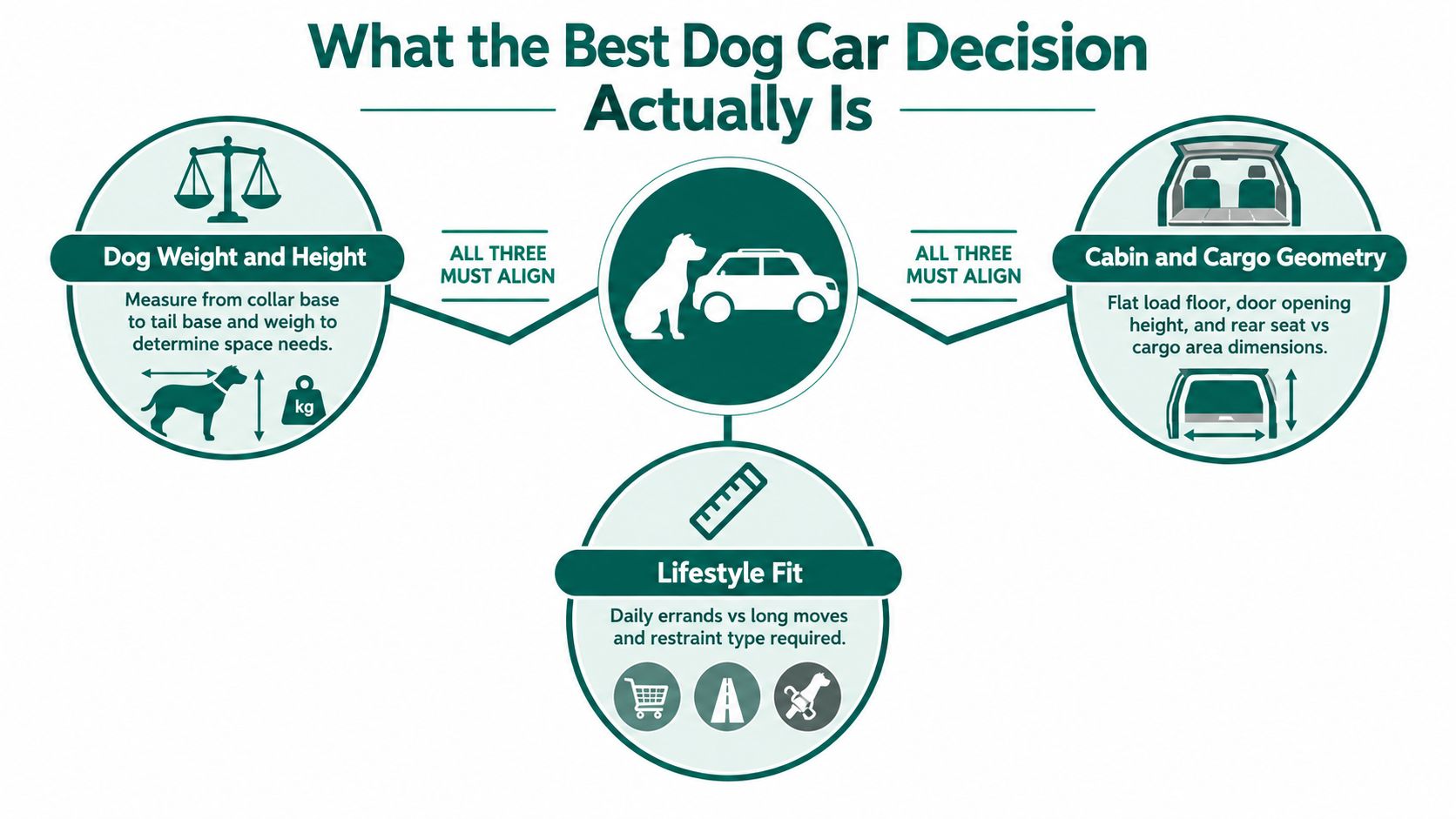
Start with the dog, not the car
Weight matters, but height and body shape matter almost as much. A compact, muscular dog and a long, leggy dog can weigh the same and need very different ride spaces. A deep-chested dog often needs better posture support on longer drives. A short-legged senior may need a lower step-in height even if the dog isn't large.
That's why the “best dog car” question usually has no single answer. A sedan can be excellent for a medium dog riding in a crash-tested rear-seat harness. The same sedan can be a miserable choice for a large dog that really needs an anchored crate.
Practical rule: If the restraint doesn't fit the dog well and the vehicle can't support the restraint correctly, the rest of the shopping list doesn't matter.
The restraint decides the vehicle
A lot of owners think in terms of cargo room. That's too vague. The useful questions are more specific.
- Rear-seat use: Does the dog ride in a crash-tested harness or booster?
- Cargo use: Can the vehicle anchor a crate securely and keep the dog in a climate-controlled area?
- Entry and exit: Can the dog load without jumping awkwardly or being lifted every time?
- Trip use: Is this mostly errands, weekend drives, or full-day transport?
The crash-test lens should drive every recommendation in this article. If a restraint lets the dog surge too far forward or if the hardware fails under load, that's a safety failure whether it happens in a sedan, crossover, or truck.
Four filters that matter
The strongest buying framework uses four filters, in this order:
- Body-style fit: Sedan, SUV/crossover, or pickup
- Restraint validity: Independent testing with published criteria
- Stress reduction: Easy loading, stable footing, rear climate flow
- Monitoring habits: Breaks, observation, updates, and emergency planning
That's the best dog car decision. It's not about buying the biggest thing in the lot. It's about building a setup that works on the road, in traffic, and during the kind of trip the dog takes.
The Crash-Test Criteria That Decide It
A dog restraint earns trust only when the seller shows the test setup, the speed, and the pass criteria. If those details are missing, “crash-tested” is marketing copy.
Use a simple standard. Look for independent testing under a named protocol, with published results for four things: forward movement, strap slack after impact, hardware and webbing integrity, and whether the dog stayed contained. Those four checks decide whether you are buying a restraint or a prop.
A lot of owners get distracted by padding, fabric, and comfort claims. In a real stop or impact, the hard questions are blunt. How far did the dog move? Did the tether stretch too much? Did any buckle, stitch line, or anchor point fail? Did the dog stay in the restraint or crate after the hit?
Four Crash-Test Criteria at a Glance
| Criterion | What It Measures | Pass Threshold | Common Failure |
|---|---|---|---|
| Excursion distance | How far the dog moves forward in a crash | Must stay within the stated test limit for the dog size | Dog surges too far forward |
| Strap loosening | How much webbing gives under load | Minimal loosening that stays within pass criteria | Excess slack after impact |
| Hardware integrity | Whether buckles, tethers, and webbing stay intact | No total separation or tear-through | Buckle breaks or webbing fails |
| Containment | Whether the dog stays restrained or inside the crate | Full containment after impact | Door blow-out, tether release, panel separation |
The benchmark that actually matters
For harnesses, the useful benchmark is a frontal sled test at highway-crash speed with disclosed excursion limits and no structural failure. For crates, the useful benchmark is full containment after impact plus no tear-out at the door, stitching, zipper, or anchor points.
One published testing method based on child-restraint crash thresholds uses these excursion limits: 32 inches or less for dogs up to 50 pounds and 36 inches or less for dogs from 51 to 75 pounds. It also treats tether separation, buckle failure, and webbing tear-through as disqualifying failures. That is the kind of threshold buyers should demand on the product page, in the manual, or from customer support.
Those numbers matter because they change the vehicle decision. A small dog in a well-fitted rear-seat harness can be a reasonable setup if the harness stays within excursion limits. A big dog with long body length often pushes that system to its limits and is usually better served by an anchored crate in a vehicle that can hold it correctly.
If the seller cannot name the test speed, the protocol, and the pass criteria, skip it.
What to ignore
Ignore labels like “safety rated,” “road ready,” “travel approved,” and “durable.” None of that tells you what happened under crash load.
Ignore “crash-tested” claims with no result details.
Ignore polished product photos showing a dog clipped in with a slack tether and no explanation of anchor geometry. Slack is movement. Movement is impact force.
The decision framework in this article starts here for a reason. Crash thresholds decide the restraint type first. Then you match that restraint to the dog's size, the cabin or cargo shape, and the length of the trip.
Matching Vehicle Type to Your Dog
Vehicle choice matters, but not for the reasons most buyers think. Horsepower doesn't matter. Fancy upholstery doesn't matter. What matters is where the dog rides, how the dog gets in, and whether the restraint can work as designed.
Vehicle Body Style vs Dog Transport Fit
| Dimension | Sedan | SUV / Crossover | Pickup |
|---|---|---|---|
| Rear-seat harness use | Usually strong for small to medium dogs | Strong for small to large dogs | Mixed, depends on cabin size |
| Cargo crate use | Usually poor to limited | Usually the best option | Possible only with proper secure enclosed setup |
| Entry height | Lower step-in at side doors | Moderate, varies by model | Highest, often needs a ramp |
| Rear-seat access | Easy for many dogs | Usually easy with wider openings | Rear seat can be tight in some cabs |
| Climate control to dog area | Good in cabin | Good in cabin, variable in cargo areas | Highest risk if dog rides outside main cabin |
| Best fit | Small and medium dogs in back seat | Most dogs and most trip types | Working dogs with proper crate setup |
| Main weakness | Trunk layout is useless for dog transport | Tailgate height and third-row packaging can complicate access | Climate and containment mistakes are common |
Sedans work better than people think
For a medium dog in a rear-seat harness, a sedan can be a smart pick. The lower ride height helps older dogs and shorter dogs get in without launching themselves. Rear cabins are usually climate-controlled, and side-door loading is straightforward.
Where sedans fail is crate transport for bigger dogs. The trunk doesn't count as dog space. It separates the dog from the cabin, limits monitoring, and doesn't function like a safe pet area. A large dog that really belongs in a crate will usually outgrow what a sedan can handle safely.
SUVs and crossovers are the all-around answer
For most households, this body style gives the widest margin for doing things right. Rear seats usually fit harnessed dogs well. Cargo areas often work for anchored crates. Door openings are wider. Roof height is better for tall dogs and crates.
That doesn't mean every SUV is automatically good. Some have sharply sloped cargo floors, awkward third-row fold lines, or little usable depth behind the rear seats. Buyers should check flat floor length, tie-down placement, and whether the dog can enter without twisting.
Rear-seat safety and cargo-area safety aren't interchangeable. The same vehicle can be excellent for a harnessed dog and poor for a crate, or the other way around.
Pickups need the most discipline
A pickup can work for dogs, but only with a real plan. Open-bed transport is a bad idea. Even in an enclosed topper, a dog still needs secure containment, stable footing, and reliable climate conditions. Without those, the setup becomes a rolling weather problem.
Pickups fit best when the dog is crate-trained, the crate is anchored properly, and loading happens with a ramp or controlled lift. That usually suits working dogs, sport dogs, or households already committed to crate travel. It doesn't suit casual “the dog will figure it out” transport.
A practical match looks like this:
- Small dogs: Sedan or crossover usually works well
- Medium dogs: Sedan works for harness use, crossover gives more flexibility
- Large dogs: SUV/crossover is usually the cleanest answer
- Very tall, reactive, or crate-dependent dogs: Focus on crate fit and anchor geometry before anything else
Fitting the Restraint to Dog Size and Breed
A 12-pound dog sliding around in an oversized harness is not safer because it is technically restrained. A 90-pound shepherd clipped to a flimsy seat-belt tether is not “good enough” because he rides. Size decides force. Build decides fit. Crash-tested limits decide what category the dog belongs in.
Breed labels confuse people. Body weight, chest depth, leg length, and how the dog settles in the car matter more. Use breed only to catch shape problems, not to choose the restraint in the first place.
Start with the dog's actual transport class. Small dogs usually fit a crash-tested booster or a compact rear-seat setup. Medium dogs are the easiest match for a crash-tested harness. Large dogs split into two groups: solid rear-seat harness candidates and dogs that should go straight to an anchored crate because of height, mass, or behavior. Extra-large dogs usually do best in a properly secured crate if the vehicle can support it.
Restraint by Dog Size and Weight
| Dog Size | Weight Range | Best Starting Point | Anchor Method | What to Verify |
|---|---|---|---|---|
| Small | Under 20 lb | Crash-tested booster or compact harness setup | Three-point seat belt path or approved rear-seat attachment | Published crash results and limited forward movement |
| Medium | 20 to 50 lb | Full-body crash-tested harness | Rear seat belt path or approved attachment point | Published excursion and hardware integrity results |
| Large | 51 to 75 lb | Harness or anchored crate, based on body shape and vehicle fit | Rear seat for harness, cargo anchors for crate | Size-specific test results and secure attachment geometry |
| Extra large | Over 75 lb | Anchored crate in most cases | Secured cargo-area anchor points | Containment, latch strength, and structural survival in testing |
Small dogs need support, not extra slack. If the dog is tiny, low to the seat, and prone to sliding, a well-secured booster often works better than a long harness setup that lets the body pitch forward. The goal is controlled movement, not a lot of movement.
Medium dogs are the cleanest harness candidates. A good rear-seat harness setup gives enough room to sit or lie down without letting the dog reach the front row. This is the range where harnesses usually make the most sense for everyday owners.
Large dogs are where people make bad calls. A tall, deep-chested dog creates serious forward load in a sudden stop, and long tethers make that worse. If the dog sprawls across the bench, braces poorly, or gets amped up in traffic, stop trying to force a harness solution. Use an anchored crate if the vehicle has the floor length, height, and tie-down geometry for it.
Shape matters as much as weight.
- Brachycephalic dogs: Prioritize airflow, cooler cabin temps, and fast loading. Heat stress shows up early in these dogs.
- Sighthounds: Check body length and sternum clearance. Long, lean dogs often outgrow standard harness geometry before they outgrow the stated weight range.
- Herding and working breeds: Many travel better with firmer boundaries. A crate often settles the dog faster than a rear-seat setup with too much visual stimulation.
- Senior dogs: Stable footing and easy entry matter more than giving them extra cabin space they cannot brace in.
For owners sorting through tethers, barriers, seat covers, ramps, and crate add-ons, this guide to dog travel accessories helps round out the restraint plan without guessing.
One mistake shows up constantly. People buy for the dog's label instead of the dog's measurements and the restraint's tested limits.
Three failures cause most bad setups:
- Loose harness fit: Snug it up so the chest stays supported and the dog cannot build speed before the restraint engages.
- Crate sitting loose in cargo: Anchor to real tie-down points. A crate that slides is cargo, not protection.
- Improvised belt routing: Use the restraint exactly as it was tested. Shortcuts change how force hits the dog and the hardware.
A loose chest strap is not kindness. In a crash, it is runway.
Everyday Trips Versus Long-Distance Moves
Trip length changes the rules. A setup that's fine for a quick hardware-store run can turn into a miserable and unsafe arrangement on a relocation day.
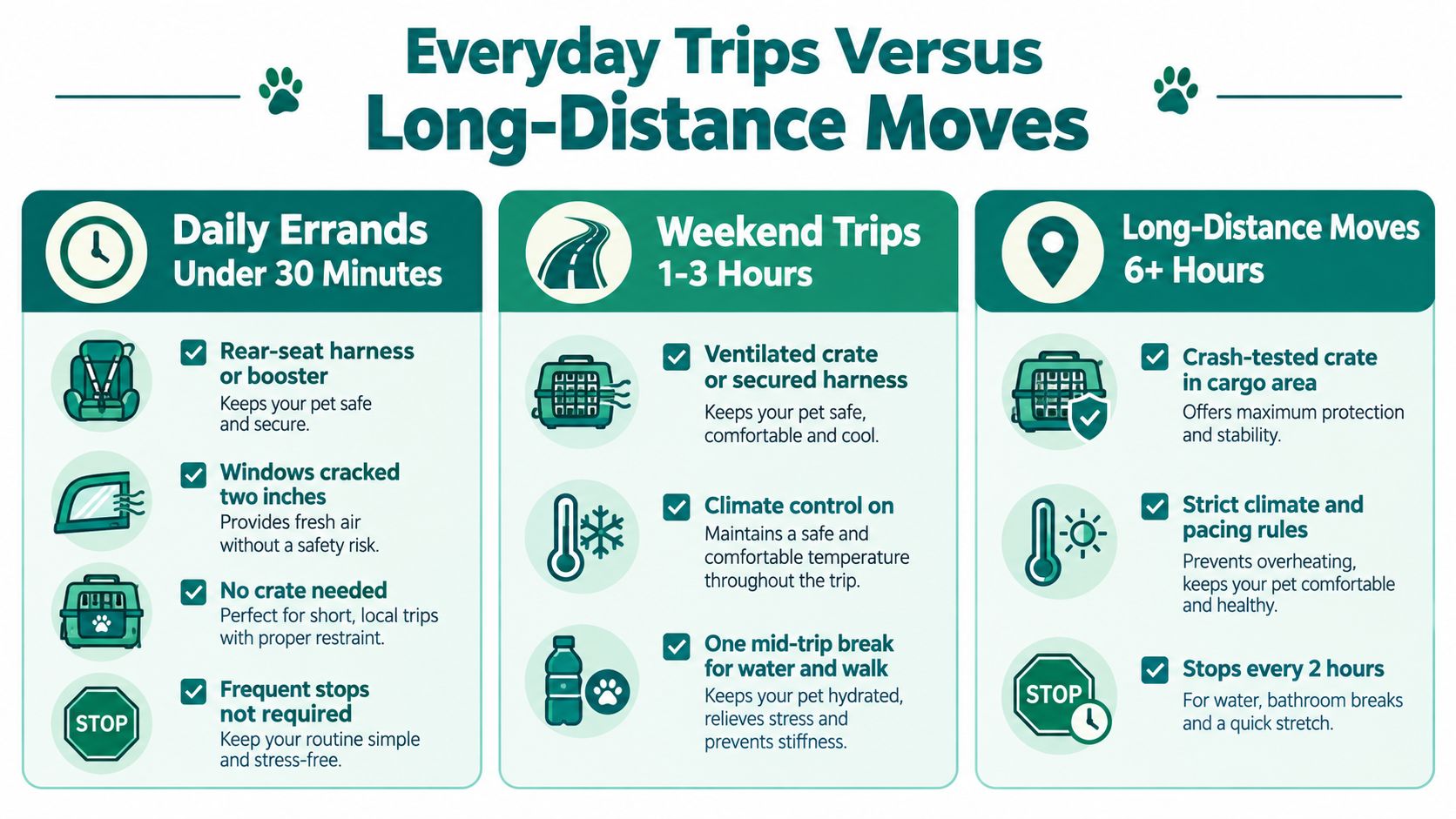
Daily driving needs simplicity
For errands and short routine drives, the goal is restraint, not overengineering. A rear-seat harness for most dogs, or a properly secured booster for very small dogs, is usually enough if the setup is stable and the dog can settle quickly.
The mistake is letting “it's just a short trip” become permission for no restraint at all. Short drives still include red lights, sudden stops, lane changes, and distracted traffic.
Weekend trips need better pacing
Once the drive gets longer, comfort and monitoring matter a lot more. Dogs shift around, drink water, pant harder, and fatigue mentally. A dog that rides calmly for fifteen minutes may struggle after a few hours.
That's where owners should tighten the routine:
- Use stable containment: Harnessed rear-seat dogs need a well-fitted setup. Restless dogs may do better in a secured crate.
- Manage the cabin: Keep airflow consistent and don't let the rear section turn stuffy.
- Plan the stop rhythm: Long stretches without a break often backfire.
A more detailed prep list for longer drives appears in this guide on how to prepare a dog for long-distance transport.
This video gives a helpful visual overview of car travel basics before a longer run:
<iframe width="100%" style="aspect-ratio: 16 / 9;" src="https://www.youtube.com/embed/qFx3ZIPyjUo" frameborder="0" allow="autoplay; encrypted-media" allowfullscreen></iframe>Relocations need a transport mindset
A relocation isn't a bigger weekend trip. It's a different category.
Dogs on full-day drives need stricter containment, steadier pacing, and actual observation. The owner should know where the dog will rest, how water will be offered, and what happens if the dog starts showing stress signals or motion sickness.
A dashboard-level checklist helps:
- Before departure: restraint check, leash ready, water packed, cleanup kit accessible
- During drive: watch posture, breathing, drooling, and agitation
- At stops: controlled exits only, no door popping without leash control
- At arrival: don't expect the dog to be normal immediately
A dog that handles local park runs well may still fatigue, panic, or vomit on a relocation drive. Those are not the same test.
When a Verified Driver Beats Driving Yourself
You are six hours into a relocation. Your dog has already burned through your attention at fuel stops, your cargo area is cramped, and you still have half a day left. That is the point where "I'll just drive him myself" stops being responsible planning and starts becoming avoidable risk.
A verified driver is the better call when the trip asks for more control than your setup can deliver. This usually happens with full-day moves, dogs that need tight handling, households moving more than one pet, and owners who cannot keep eyes on the dog while also driving safely. The decision is not about convenience. It is about containment, monitoring, and whether the person in charge can stay sharp for the whole run.
The checks that matter
Industry transport checklists keep coming back to the same questions because they expose weak operators fast. Ask whether the transporter is federally registered where required, bonded, and properly licensed. Ask how the dog rides, how the crate or carrier is anchored, whether sedation is ever used, how water and meals are handled, what the escape protocol is, and how updates are delivered during the trip.
Those questions matter more than polished marketing copy. A transporter can say all the right comforting words and still have loose crates, vague stop routines, or no real emergency process.
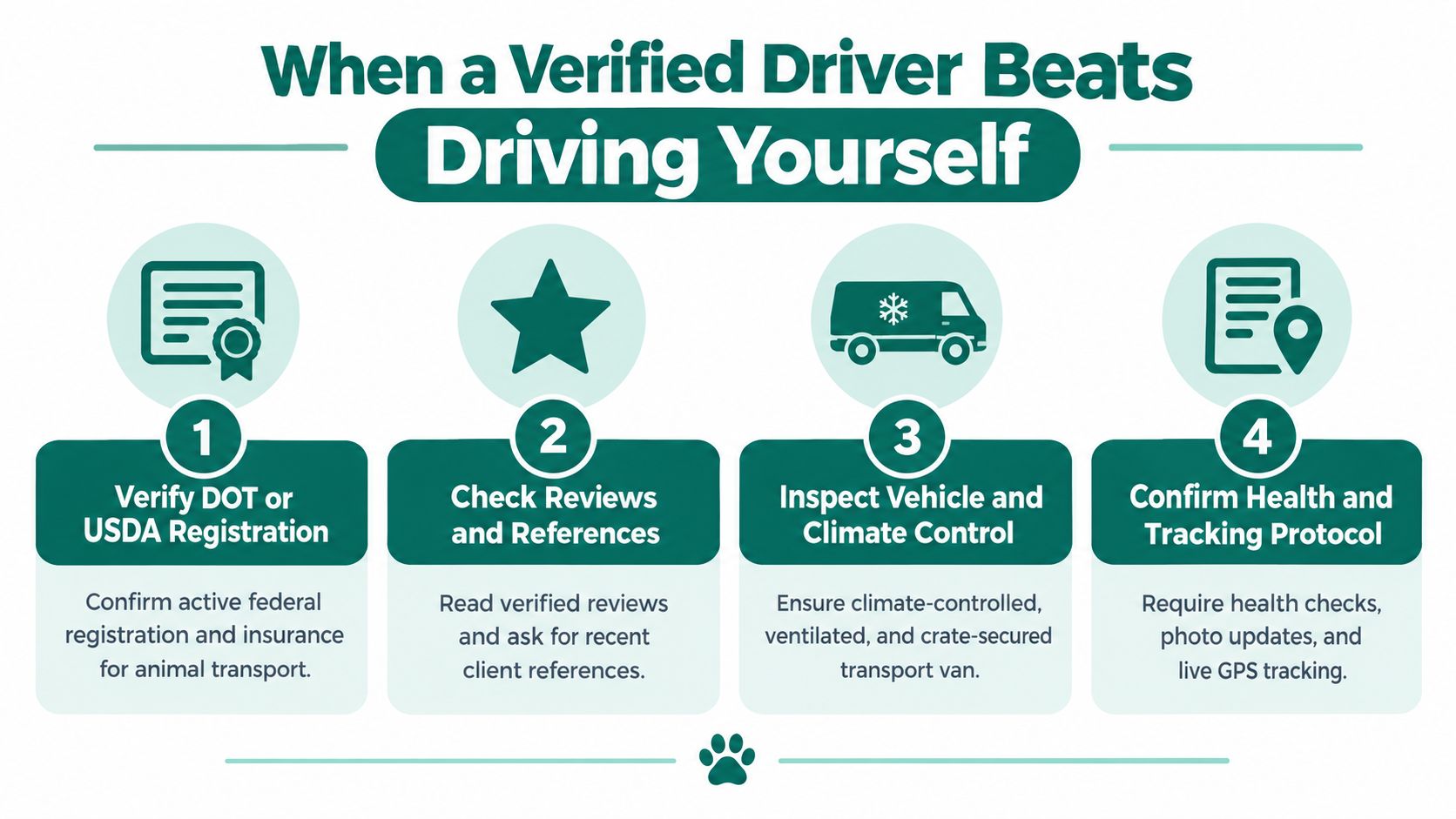
Use this short screening standard:
- Credentials: Confirm active registration and ask for proof, not a verbal yes.
- Restraint method: Get a plain answer on crate type, tie-down points, and where the dog rides in the vehicle.
- Driver oversight: Ask who is responsible for checks during the route and how often the dog is observed directly.
- Emergency handling: Require a clear plan for illness, escape, traffic delays, and heat exposure.
- Updates: Set the expectation for photo, phone, or GPS check-ins before you book.
If you want a clearer picture of what owners should ask before handing off a dog, this guide to ground dog transport lays out the service details that matter.
When hiring out is the smarter call
Some cases are straightforward. Hire the driver.
- a dog recovering from surgery or dealing with age-related mobility limits
- a reactive dog that is harder to unload and reload safely at public stops
- multiple dogs that push your vehicle past a safe restraint layout
- a solo relocation where driver fatigue becomes part of the hazard
- a trip length that exceeds your ability to monitor, clean up, and keep the dog settled without cutting corners
I would add one more. Hire out when your vehicle geometry is wrong for the restraint your dog needs. If your dog should be in a crash-tested crate but your car cannot fit and anchor one correctly, the decision is already made.
Ferried is one marketplace option in this category. It connects owners with verified independent ground transport drivers, provides GPS check-ins and photo updates, and holds payment until confirmed delivery. That is useful because accountability matters as much as the ride itself.
Walk away from any plan with vague restraint practices, fuzzy credentials, or loose promises about updates. That is where transport problems start.
A One-Page Decision Rule for 2026
Most owners don't need a giant spreadsheet. They need a rule they can use in the driveway before the next trip.
The best dog car decision for 2026 comes down to four checks, in order.
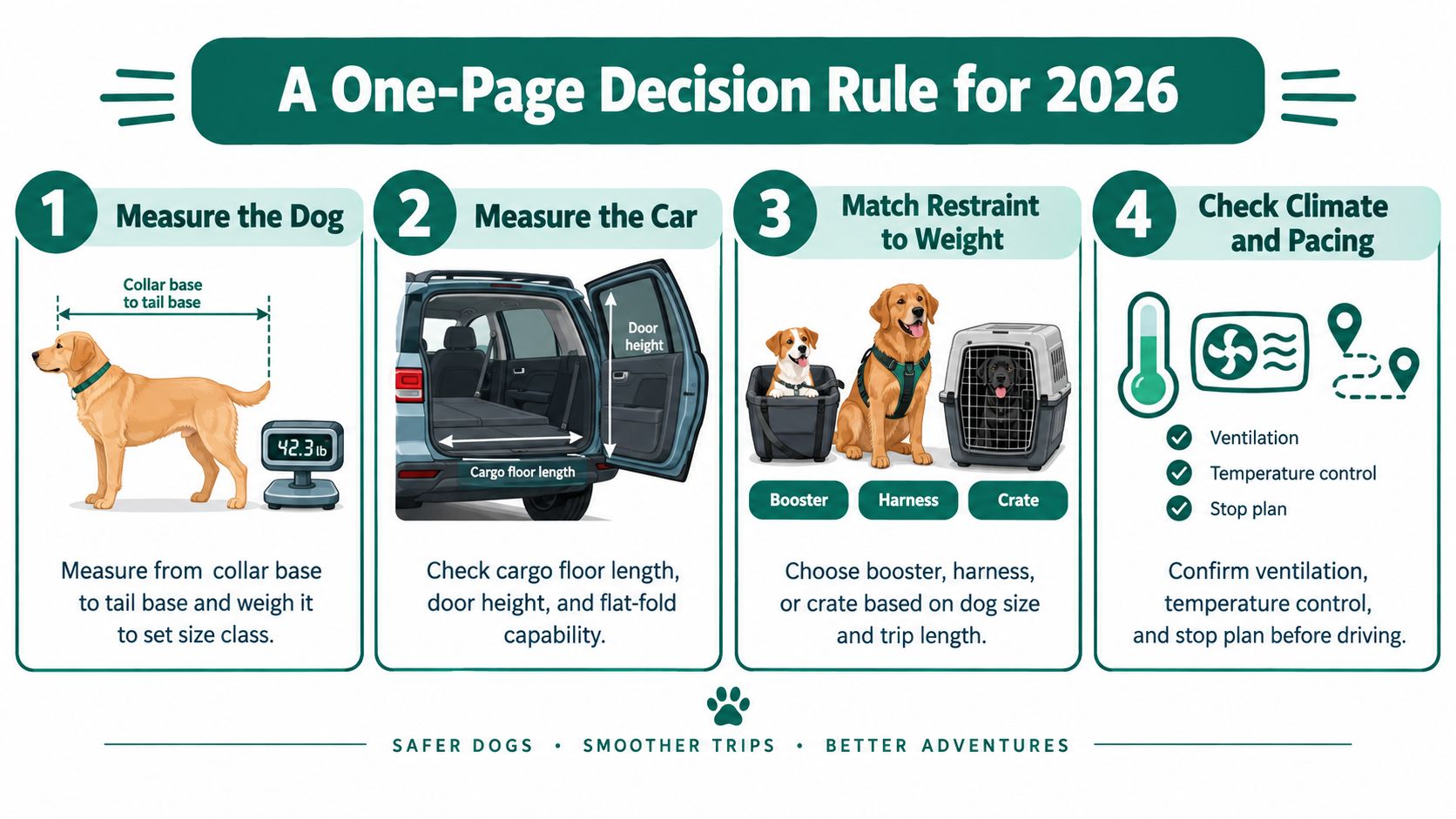
Check the dog first
Measure the dog's usable body size, not just the breed label. A buyer should know whether the dog fits the small-dog rear-seat category, the medium harness category, or the large crate-leaning category.
Then look at how the dog travels. Calm dogs earn more flexibility. Dogs that pace, spin, drool, or brace on turns need tighter management.
Check the restraint next
A buyer should only trust restraints that disclose meaningful testing details. If the package doesn't clearly state how the product was evaluated, that's a warning sign. Marketing language isn't safety data.
The smart question is blunt: did the restraint stay intact, limit forward movement appropriately, and keep the dog contained under a named crash setup?
Match it to the vehicle
The best dog car question finally gets answered.
- Rear-seat harness dog: A sedan or crossover may be perfectly good.
- Large crate dog: An SUV or crossover with a usable cargo layout is usually the better answer.
- Truck owner: The setup has to solve climate, anchoring, and loading before the trip should happen.
A bad vehicle for a good restraint is still a bad setup.
Set the trip rule before leaving
Trip length should trigger a different standard, not the same routine stretched longer.
- Short local drive: restrained dog, quick confirmation that the fit is right
- Longer road day: stronger pacing, better hydration planning, tighter monitoring
- Relocation or stress-prone dog: consider handing the trip off to a verified transport pro
The handoff point is simple. If the dog can't be monitored well, can't be contained correctly in the available vehicle, or the driver can't realistically manage the trip safely, driving personally stops being the best option.
That's the answer to the best dog car search. Choose the restraint by crash-test logic, choose the vehicle by geometry, and choose the travel plan by the dog's actual tolerance.
Ferried helps owners who need more than a product recommendation. It gives them a way to compare verified ground transport drivers, review bids, and follow trips with GPS check-ins and photo updates when a dog needs door-to-door vehicle travel. For relocations, multi-pet moves, or dogs that won't do well on a long DIY drive, visit Ferried and compare a safer transport plan.
Ready to transport your pet?
Post your transport request for free. Verified drivers bid for your trip, you pick the best offer.
Get free quotes