Door to Door Transport Service for Pets Explained
In this article
- Table of Contents
- Introduction to Door to Door Pet Transport
- What Door to Door Transport Service Means for Pets
- How Door to Door Transport Works From Pickup to Delivery
- Door to Door Ground Transport Compared With Airport and Kennel Options
- What Door to Door Pet Transport Costs and What Affects Pricing
- Safety Checks and What to Expect When Booking on Ferried
- Planning Your Pet Move With Confidence
A family relocation is already full of moving parts. The lease is signed, the new address is confirmed, and then one practical question stops everything: how will the dog, cat, or other household pet travel safely from the current home to the new one without an airport handoff, a cargo hold, or an unfamiliar kennel?
A door to door transport service for pets is designed around that exact problem. A driver collects the animal at the origin address, provides vehicle-based care during the journey, and delivers the pet to the destination address. The model can suit families moving between states, rescue organizations arranging transfers, breeders coordinating delivery, and owners whose pets are difficult or unsuitable to fly.
Ground transport has also become a meaningful part of the wider pet travel category. Industry coverage estimates the U.S. pet transportation services industry at $2.2 billion in 2026, while global pet travel services are projected at $2.42 billion in 2026, with domestic trips representing 73.7% of demand according to market coverage of pet transportation services. Those figures don't tell an owner what a particular trip will cost, but they show why clear booking standards matter in a growing and varied market.
This guide follows the complete home-to-home journey. It explains what door-to-door transport means, what happens from posting a request through delivery, how ground transport compares with air and kennel handoffs, why prices vary, and which safety controls deserve close attention before booking.
Table of Contents
- Introduction to Door to Door Pet Transport
- What Door to Door Transport Service Means for Pets
- How Door to Door Transport Works From Pickup to Delivery
- Door to Door Ground Transport Compared With Airport and Kennel Options
- What Door to Door Pet Transport Costs and What Affects Pricing
- Safety Checks and What to Expect When Booking on Ferried
- Planning Your Pet Move With Confidence
Introduction to Door to Door Pet Transport
Consider a household moving from one state to another with an older dog who becomes distressed in unfamiliar environments. The family may not have enough time for a long drive, the dog may not be a suitable candidate for air travel, and asking a friend to manage the journey could create more uncertainty than relief. A direct vehicle trip offers a different arrangement: the dog leaves from the family home and arrives at the new home without requiring the owner to coordinate several separate transport stages.
That directness is the central value of a door to door transport service. The pet doesn't travel to a departure depot, wait for a later handoff, and then move through another facility before reaching the destination. Instead, the driver remains responsible for the journey between the agreed pickup and delivery points, with the exact route and stop plan shaped by the booking.
The idea itself isn't new. In the United States, postal rural free delivery began on October 1, 1896, with three routes in West Virginia. It expanded to 44 routes across 29 other states within one year and became a permanent service in July 1902, when more than 8,500 rural carriers were operating, as documented in historical and market information about door-to-door auto transport. The underlying principle was simple, service came directly to the customer's location instead of requiring a depot visit.
Practical rule: Owners should think of door-to-door transport as a complete chain of responsibility, not merely a longer taxi ride for a pet.
The modern market includes both private arrangements and peer-to-peer marketplaces. Ferried connects pet owners with independent, verified ground drivers, allowing owners to post trip details, review bids and driver information, communicate in the platform, and arrange vehicle transport across the United States. That structure can be useful when a household needs a route, timing, pet profile, and service level matched together rather than buying a generic ticket.
The right choice still depends on the animal, route, health needs, timing, and owner's comfort with the provider. A careful booking begins with those details, not with a headline price.
What Door to Door Transport Service Means for Pets
The easiest analogy is a private car service compared with a bus depot. A depot model requires the passenger to reach a fixed location, follow a schedule built for many travelers, and possibly change vehicles or collect belongings elsewhere. Door-to-door pet transport starts at the animal's actual origin address and ends at the destination address.
For a pet, the service usually has three connected parts:
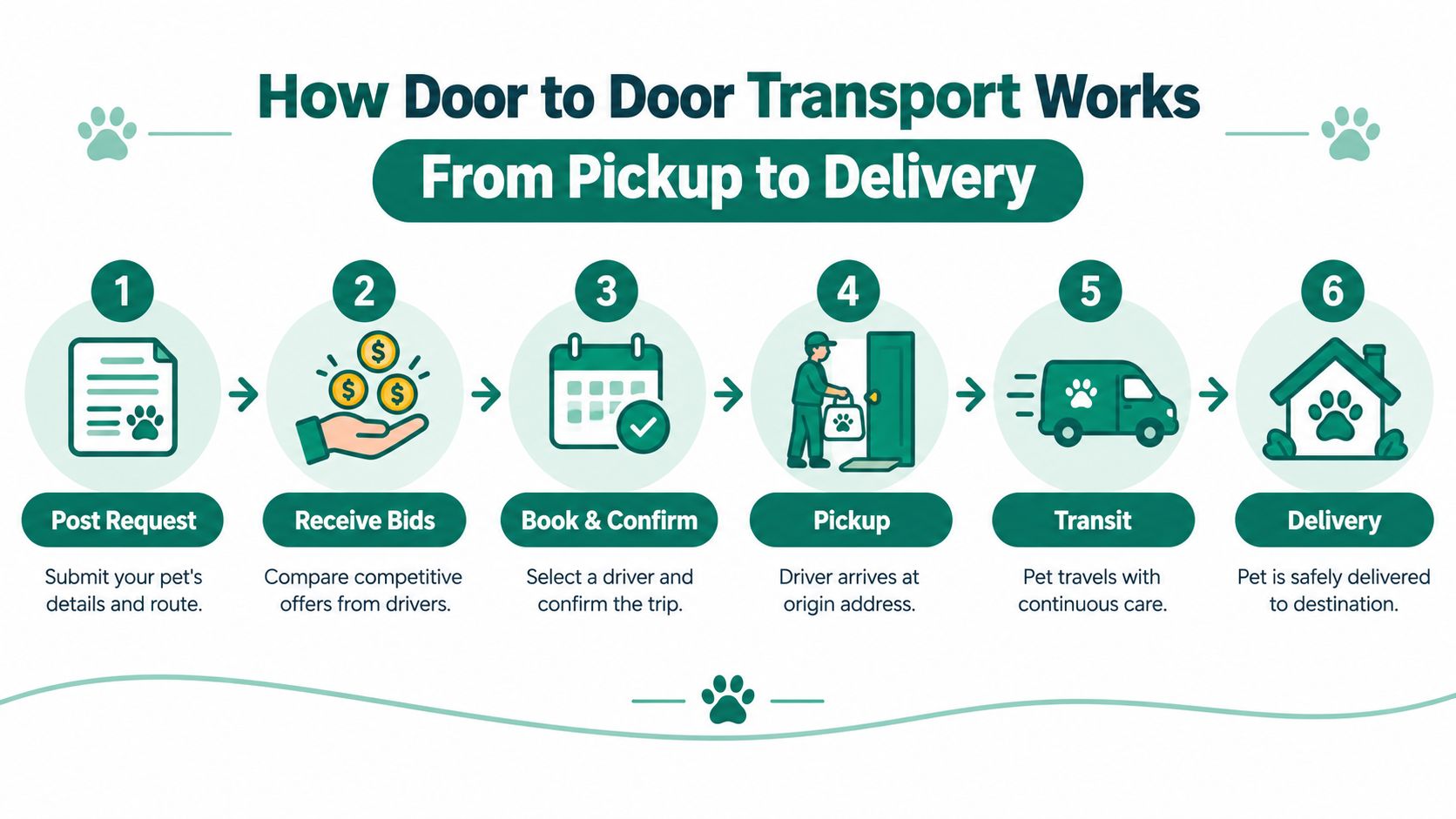
- Pickup at the origin. The driver arrives at the agreed address, confirms the pet and handoff details, and receives any supplies or instructions included in the booking.
- In-vehicle transit. The animal travels by road while the driver manages the planned route, stops, communication, and care requirements agreed with the owner.
- Delivery at the destination. The driver meets the receiving person at the confirmed address and completes the handoff.
That arrangement reduces the number of transfers. Each transfer can introduce a new person, vehicle, enclosure, waiting area, or set of instructions. Fewer handoffs don't remove every travel risk, but they make responsibility easier to follow and can reduce the disruption caused by unfamiliar environments.
Why the route is flexible
Door-to-door pet transport is commonly demand-responsive, which means the trip is built around requested origins, destinations, dates, and animal needs rather than a fixed public route. Some trips are private. Others are shared rides, where a driver carries multiple pets whose routes can be combined.
Transport research describes this pattern as a few-to-one structure inbound and a one-to-few structure outbound. In practical terms, a driver may collect pets from several origins before moving toward a destination area, then deliver animals to different homes along the route. The transportation research paper on demand-responsive shared rides explains why this flexibility reduces transfer friction while making pickup order, dwell time, vehicle occupancy, and schedule buffering more complicated.
A pet owner may see only “pickup” and “delivery” in a booking. Behind those labels, the driver has to sequence stops so one late handoff doesn't disrupt the rest of the route. That's why an accurate address, realistic availability window, crate information, pet temperament, and special-care notes matter.
The service isn't automatically private, nonstop, or faster than every alternative. Those details depend on the selected arrangement. What defines the model is home pickup, vehicle-based transport, and destination delivery under a coordinated plan.
<iframe width="100%" style="aspect-ratio: 16 / 9;" src="https://www.youtube.com/embed/uF4TSSuCojc" frameborder="0" allow="autoplay; encrypted-media" allowfullscreen></iframe>How Door to Door Transport Works From Pickup to Delivery
A smooth booking starts before the vehicle arrives. The owner supplies enough information for drivers to judge the trip accurately, including the pet's species, size, breed, temperament, number of animals, origin, destination, preferred timing, and any mobility or health considerations. Vague details can produce unsuitable bids or require changes after booking.
The booking sequence
- Post the request. The owner describes the route and the pet's needs. A dog who guards food, a cat who requires a particular carrier, or several pets traveling together should be identified at this stage.
- Review bids. Drivers respond with offers based on the requested route and service requirements. The owner can compare price, schedule, profile information, reviews, and relevant experience instead of accepting an unknown driver automatically.
- Message before confirming. Written communication helps both sides clarify pickup access, delivery contacts, supplies, rest stops, medication instructions, and what updates the owner expects.
- Book the trip. Once the driver and terms are suitable, the owner confirms the booking and checks the final details. The Ferried booking process provides the platform's route from request through delivery.
- Prepare the pet and home. The pet should be ready at the agreed time with the required carrier, leash, food, medication, records, and contact information. The receiving person should also be available and know where the handoff will happen.
- Complete delivery. The driver provides trip updates during transit and confirms the final handoff. On Ferried, payment is held through the platform and released after the owner confirms safe delivery.
What owners should prepare
Preparation works best when it removes decisions from pickup day. The owner should label supplies, provide concise written care instructions, and make sure the driver has a working phone number for both ends of the route. A receiving contact should know whether the pet arrives at a home, apartment entrance, shelter, veterinary office, or another approved location.
GPS check-ins and photo updates give the owner visibility during the trip, but they don't replace accurate instructions. If the pet has a medication schedule, feeding restriction, anxiety trigger, or handling concern, those details belong in the booking conversation before travel begins.
Timing also deserves realistic expectations. A shared ride can include planned pickups and deliveries, so the estimated arrival window may differ from the direct driving time shown by a map. Owners should ask how the driver handles delays, unavailable recipients, severe weather, and changes in access at either address.
The final handoff is more than a message saying the vehicle arrived. The receiving person should identify the pet, inspect the animal's immediate condition, collect belongings, and confirm delivery through the platform. That final confirmation closes the operational loop and triggers the agreed payment release.
Door to Door Ground Transport Compared With Airport and Kennel Options
Pet owners often compare three broad arrangements: a ground vehicle that goes from home to home, air travel that uses an airport and airline procedures, or a kennel and depot model involving one or more facility handoffs. None is right for every animal. The useful question is which arrangement fits the pet's health, size, temperament, route, and the owner's need for control.
| Transport Method | Pickup and Delivery | Pet Handling | Key Limitation |
|---|---|---|---|
| Ground door to door | Pickup at the origin address and delivery to the destination address | Vehicle-based care with direct communication and fewer planned handoffs | Travel time can be longer, and shared routes require schedule coordination |
| Air cargo or cabin | Owner or representative usually coordinates airport arrival and destination collection | Airline and airport procedures govern handling; cabin rules may depend on carrier and aircraft requirements | Size, breed, health, route, and airline restrictions can limit eligibility |
| Kennel or depot handoff | Owner delivers to or collects from a fixed facility, sometimes with separate transport legs | Care passes through facility staff or multiple handlers | More transfers can mean more instructions, waiting, and responsibility gaps |
Where ground transport often fits
Ground transport can be especially practical for large dogs, snub-nosed breeds, anxious animals, and households with multiple pets when airline rules or airport logistics create a poor fit. It also gives owners a clearer communication path during the journey, particularly when the provider offers location check-ins and photos.
A pet who becomes unsettled around crowds may cope better with a familiar carrier and a consistent vehicle environment than with airport queues and cargo procedures. That doesn't mean every road trip is calm. Long travel still requires appropriate ventilation, secure containment, rest planning, and honest disclosure of the animal's behavior.
Air travel can make sense when distance and timing are the dominant concerns, the pet meets the relevant requirements, and the owner is comfortable managing airport handoffs. Cabin travel may offer close owner contact when available, while cargo arrangements can introduce rules that vary by airline, aircraft, season, breed, and destination.
For a fuller explanation of the ground option, owners can review this guide to ground transport for dogs. The key decision isn't whether one method sounds more modern or convenient. It's whether the entire chain, from the front door to the receiving person, matches the pet's needs.
What Door to Door Pet Transport Costs and What Affects Pricing
A single flat price for pet transport is usually misleading. The final bid reflects the route, vehicle space, care requirements, timing, and number of animals, so a short metropolitan move and a long interstate relocation shouldn't be expected to cost the same.
The main pricing variables
Route length usually has the clearest effect. A local move may involve limited driving and a simpler schedule, while a cross-country trip requires more road time, fuel planning, and coordination across multiple locations.
Pet type and size also matter. A small cat in a secure carrier occupies different space from a large dog who needs room to stand, turn, and remain safely contained. Breed-related handling needs, temperament, and special instructions can affect which drivers are suitable.
The number of pets changes the booking in practical ways. Several animals traveling together may share one route, but they still require appropriate space, supplies, and handoff planning. Owners should list every pet rather than adding animals informally after a driver has accepted the request.
Timing and flexibility influence the available bids. A narrow pickup window can make route planning harder than a broader date range. A last-minute request may also have fewer suitable options than a booking posted with time to compare drivers.
Service level can include private transport, shared travel, special handling, additional updates, or other requirements agreed before booking. The owner should compare bids against the same service expectations instead of choosing the lowest number without reading the terms.
Ferried uses competitive bidding, and its booking fee is 15% or $180 maximum, while drivers receive their full bid amount, according to the publisher's marketplace terms. That structure lets owners compare complete offers rather than relying on a generic calculator. The fee should still be reviewed alongside the driver's profile, schedule, vehicle details, and proposed care plan.
The most realistic estimate comes from posting complete information and comparing several suitable bids. A low offer may exclude a requested service, while a higher offer may reflect a private route or more specialized handling. Price realism means understanding what the bid includes before treating it as comparable.
Safety Checks and What to Expect When Booking on Ferried
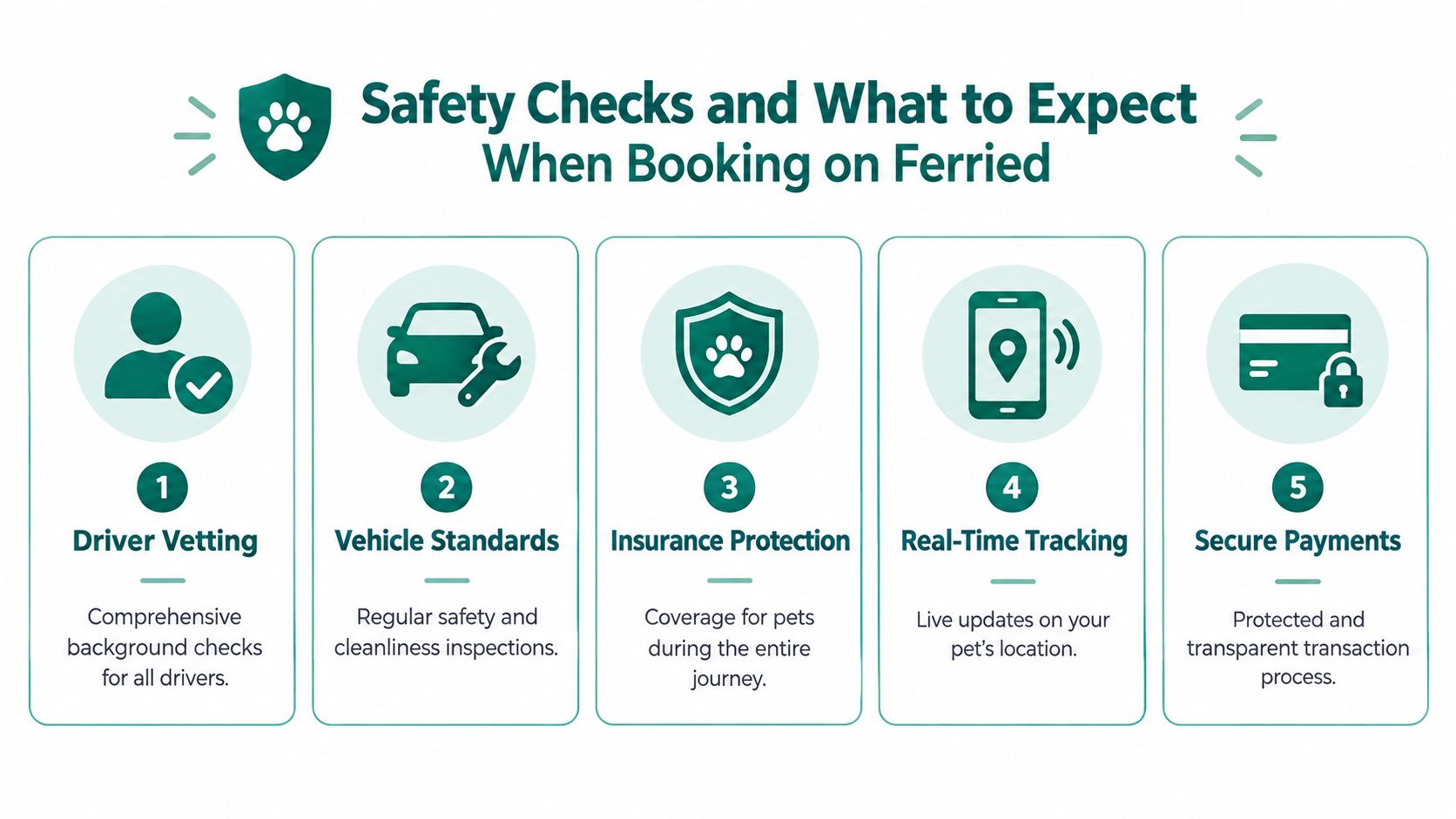
Safety doesn't come from one badge or one promise. It comes from several controls working together: a verified person, a suitable vehicle, clear communication, visibility during transit, protected payment, and a documented handoff.
Ferried requires drivers to complete background checks, identity verification, and driving record review before their first transport. Driver profiles can show experience, reviews, and verification status, giving owners information to examine before selecting a bid. Those checks don't eliminate every possible problem, but they create a stronger starting point than accepting an anonymous cash arrangement.
The controls that matter most
- Driver verification: The owner should confirm who will collect the pet and whether the person has experience with the animal's species, size, temperament, or care requirements.
- Vehicle suitability: The booking conversation should cover safe containment, cleanliness, ventilation, temperature management, and how animals are separated when more than one pet travels.
- Trip visibility: GPS location check-ins and photo updates help the owner understand where the journey stands and whether the driver is following the communication plan.
- Payment protection: Ferried holds payment until the owner confirms safe delivery. The marketplace also includes $2,000 Pet Protection on every booking at no extra cost, based on the publisher's stated service terms.
- Handoff records: The driver and receiving person should agree on the delivery contact, location, identification process, and confirmation method before pickup.
Owners still have responsibilities. Health certificates, vaccination records, medication instructions, and state-entry rules can vary by destination and animal type. A driver or marketplace can't replace a veterinarian's advice or the requirements of a state agency, so those documents should be checked before the booking date.
The biggest avoidable risk often appears before the vehicle moves. It starts with unclear terms, weak provider verification, missing documents, or a receiving person who isn't ready.
The owner should ask what happens if pickup is delayed, the recipient is unavailable, the pet becomes ill, or the route changes. Refund conditions, cancellation rules, update frequency, and emergency contacts should be clear in writing. Ferried's Trust and Safety guidance gives owners a place to review the platform's verification, payment, and protection practices.
Independent market coverage estimates that ground transport represented 32.2% of the pet transport market in 2025 and projects a 7.1% CAGR through 2034, while also describing increasing complexity in international pet movement, as reported in veterinary transport services market coverage. The figures are market projections, not a guarantee about any individual provider. They reinforce why owners should evaluate the controls behind a service rather than relying on category growth or promotional language.
Planning Your Pet Move With Confidence
A successful pet move starts with the complete route, not the vehicle alone. The owner needs a reliable origin contact, a prepared destination contact, accurate pet information, suitable supplies, and a clear understanding of what the driver will handle.
Door-to-door ground transport can reduce airport handoffs and depot transfers because the driver collects the pet at home and delivers the animal to the destination. It can be a sensible option for pets who don't fit airline requirements, animals who become distressed in crowded travel settings, and households coordinating multiple pets on one move.
A practical preparation list
- Post early enough to compare: Give suitable drivers time to review the route and offer realistic bids.
- Describe the pet clearly: Include size, breed, behavior, medical needs, carrier requirements, and whether the animal travels with other pets.
- Prepare the paperwork: Check veterinary records, health documentation, medication instructions, and destination requirements before pickup.
- Confirm both addresses: Share access instructions, parking details, contact names, and a backup communication method.
- Set update expectations: Agree on GPS check-ins, photo updates, delay notifications, and escalation steps.
- Plan the first hours after arrival: Keep food, water, medication, bedding, and a quiet space ready at the destination.
Owners should compare the whole offer, not just the bid amount. A suitable driver, clear communication, verification status, payment protection, trip visibility, and a workable delivery plan all contribute to a dependable booking.
Ferried operates as a peer-to-peer marketplace for vehicle-based pet transport across all 50 U.S. states, connecting owners with independent drivers and supporting competitive bids, driver verification, trip updates, protected payment, and delivery confirmation. The platform's structure gives owners a defined process for moving from request to comparison to booking, but each owner still needs to verify that the selected trip fits the animal's needs.
A calm booking is a prepared booking. Once the route, driver, documents, supplies, and handoff contacts are confirmed, the move becomes a series of manageable steps rather than one uncertain leap.
Ferried connects pet owners with verified independent drivers for door-to-door ground transport, with competitive bids, trip updates, protected payment, and delivery confirmation. Visit Ferried to post the pet's route, compare suitable transport offers, and arrange the journey with clearer expectations from pickup to home delivery.
Ready to transport your pet?
Post your transport request for free. Verified drivers bid for your trip, you pick the best offer.
Get free quotes