Cat with a Jacket: A Practical How-To Guide for Owners
In this article
Most advice about a cat with a jacket starts with colors, fabrics, and seasonal outfits. That's backward. The first question isn't whether a jacket looks adorable. It's whether the cat needs one, can tolerate one, and has a clear reason to wear it.
A jacket can provide warmth, weather protection, gentle pressure, or coverage during recovery. It can also restrict movement, trap heat, irritate skin, and turn a routine carrier trip into a wrestling match. Cats rarely benefit from clothing bought for appearance alone, so the right decision begins with temperament and function.
Table of Contents
- Whether Your Cat Should Wear a Jacket at All
- Measuring Your Cat for a Proper Fit
- Choosing the Right Type of Cat Jacket
- Acclimating Your Cat to Wearing a Jacket
- When a Jacket Actually Helps Your Cat
- Travel, Transport, and the Jacket Question
- Quick Checklist and When to Skip It
Whether Your Cat Should Wear a Jacket at All
Healthy cats don't automatically need clothing. A healthy adult with a normal coat and a stable indoor environment will usually be more comfortable without a jacket, especially if there's no cold outing, medical need, or transport problem to solve.
The cats most likely to benefit are hairless cats, frail seniors, underweight cats, and cats with reduced natural insulation. A shaved cat may also need temporary protection in a cold setting, but that decision belongs with the veterinary team when surgery or illness is involved. A jacket isn't a substitute for medical advice or a properly heated environment.
Temperament matters just as much as body condition. A cat that accepts handling around the torso, sniffs unfamiliar fabric, keeps relaxed shoulders, and continues eating or playing may have a reasonable chance of accepting a garment. A cat that freezes, thrashes, flattens its ears, lashes its tail, or bolts when the jacket appears is giving a clear answer.
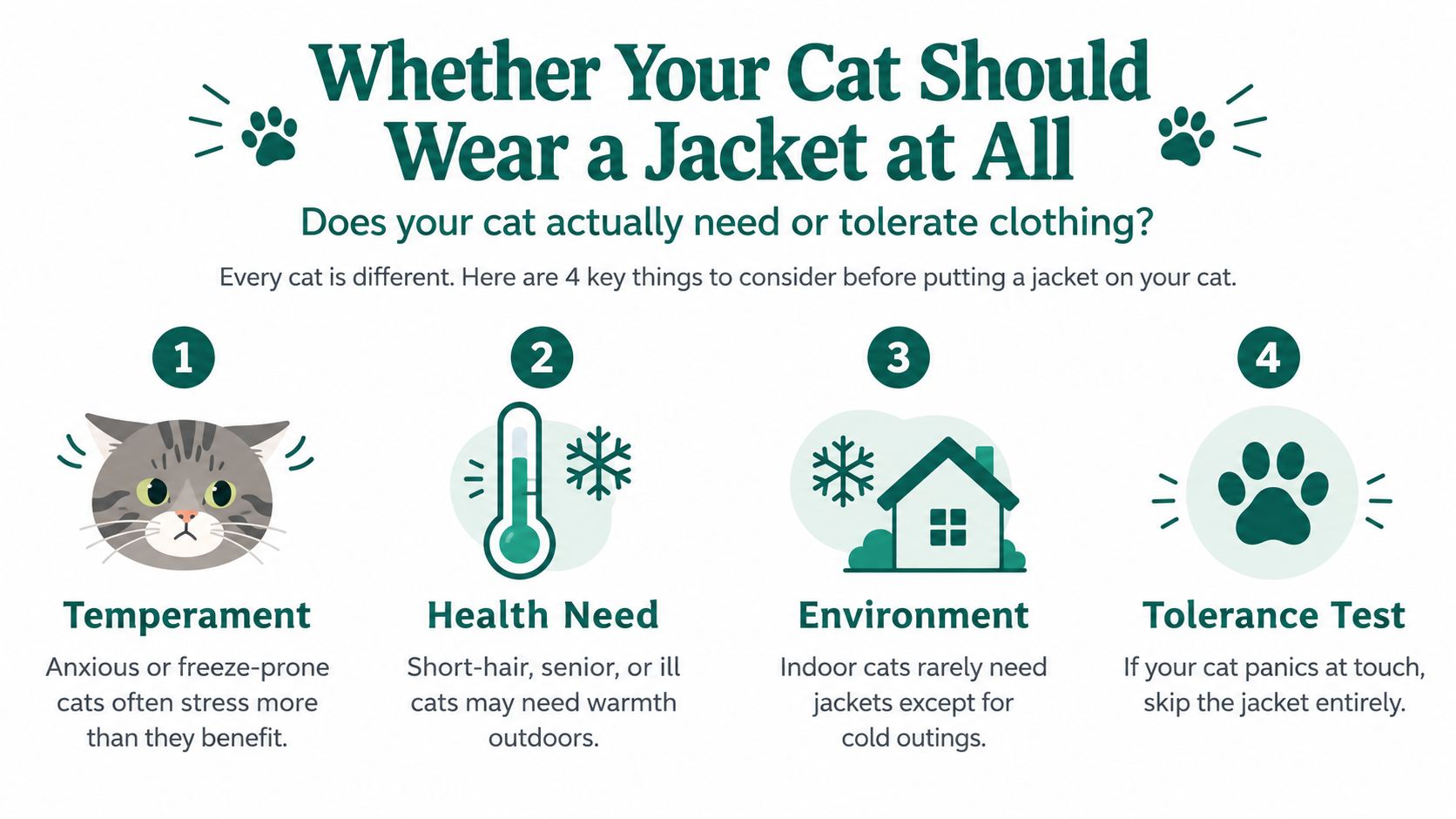
Function comes before appearance
A jacket should have a specific job:
- Warmth: Useful for cold-sensitive cats during appropriate outdoor or transport exposure.
- Weather protection: Helpful for brief, supervised encounters with rain or snow.
- Anxiety support: A pressure wrap may help some cats during stressful events, though it isn't a cure for fear.
- Recovery coverage: A recovery suit can protect an incision when prescribed or approved by a veterinarian.
- Travel handling: A garment with a secure harness connection may assist loading, but only for a cat already trained to accept it.
Veterinary guidance warns that many cats tolerate clothing poorly and may develop stress, grooming changes, chafing, or circulation problems. For a holiday appearance, a breakaway collar is often safer than a jacket, as explained in this guidance on safe and comfortable pet clothing.
Practical rule: If the cat's welfare doesn't improve, the jacket has failed, even if the outfit looks great in a photo.
The rest of the decision is conditional. If the cat fails the temperament check, skip the jacket. If the cat passes and a real need exists, accurate measurements and gradual training become worthwhile.
Measuring Your Cat for a Proper Fit
A jacket that fits the back but squeezes the chest is unsafe. Chest girth is the most important measurement because the garment must sit around the ribcage without restricting breathing or shoulder movement.
A soft fabric tape measure works best. The cat should be standing or sitting naturally, not crouched in fear. Two people make the process easier, one to handle treats and steady the cat, the other to measure without pulling the tape tight.
Take the measurements in this order
- Chest girth: Wrap the tape around the widest part of the ribcage, immediately behind the front legs. Keep the tape level and comfortably close to the fur.
- Back length: Measure from the base of the neck, where the collar normally rests, to the base of the tail. Don't measure to the tail tip.
- Neck circumference: Measure around the lower neck, leaving enough room to avoid pressure on the throat.
- Weight: Use the cat's current weight as a sanity check against the manufacturer's chart. Weight alone can't replace girth because cats vary widely in build.
A coat can match the back length and still bind under the front legs. That's why chest girth should decide the size first, with back length used to check coverage.
Cat sizing by chest girth
| Cat Size | Chest Girth | Approx. Weight | Typical Breeds |
|---|---|---|---|
| Kitten or petite | Use the manufacturer's chart | Use the manufacturer's chart | Small domestic cats and young kittens |
| Small adult | Use the manufacturer's chart | Use the manufacturer's chart | Petite domestic shorthairs |
| Medium adult | Use the manufacturer's chart | Use the manufacturer's chart | Average domestic cats |
| Large adult | Use the manufacturer's chart | Use the manufacturer's chart | Large-framed domestic cats |
| Extra-large | Use the manufacturer's chart | Use the manufacturer's chart | Maine Coons and other large-framed cats |
The table intentionally avoids made-up universal ranges. Jacket sizing isn't standardized, and a retailer's chart should take priority over a generic label.
After dressing, check the fit while the cat walks. Two fingers should fit beneath the neck opening and belly strap. The shoulders should move freely, the fabric shouldn't bunch into the armpits, and the cat must be able to sit, lie down, groom, and use the litter box without obstruction.
Choosing the Right Type of Cat Jacket
“Cat jacket” covers several very different garments. Buying the wrong type creates the wrong result, such as using a waterproof shell for indoor anxiety or expecting a recovery suit to keep a cat warm outside.
Market coverage shows that coats and jackets are a major part of pet apparel, while newer demand emphasizes lightweight, comfortable, weather-adaptive designs. The broader pet clothing market was valued at USD 5.7 billion in 2023 and is projected to reach USD 9.6 billion by 2032, according to this pet apparel market estimate. That commercial growth doesn't prove every cat needs clothing. It does show why owners should separate product marketing from actual function.
Match the garment to the problem
| Jacket Type | Primary Function | Best Use Case | Main Drawback |
|---|---|---|---|
| Insulated winter jacket | Adds warmth | Hairless, frail, or cold-sensitive cats on brief cold outings | Can overheat or restrict movement |
| Waterproof shell | Blocks rain and snow | Short, supervised exposure to wet weather | May trap heat and feel noisy or stiff |
| Anxiety wrap | Applies gentle torso pressure | Some cats during travel, storms, or handling | Doesn't provide insulation and may increase distress |
| Recovery suit | Covers the body and protects wounds | Veterinary-approved post-surgical recovery | Isn't designed as ordinary outerwear |
An insulated jacket should feel soft inside and remain light enough for normal movement. It's best reserved for a cat with a genuine need for warmth, not a healthy indoor cat in a heated home.
A waterproof shell needs breathable construction and rapid removal. Wet weather doesn't justify leaving a cat bundled up for extended periods, especially in a warm room or enclosed vehicle.
An anxiety wrap is a pressure garment, not a coat. Some cats settle with gentle, even contact, while others panic as soon as their torso feels restricted. The first trial should happen indoors, while the cat is calm, with direct supervision.
A recovery suit belongs in a separate category. Its purpose is to reduce licking or scratching around a wound, and the veterinary team should approve the fit and duration. It must never conceal swelling, discharge, or worsening irritation from the person responsible for care.
Acclimating Your Cat to Wearing a Jacket
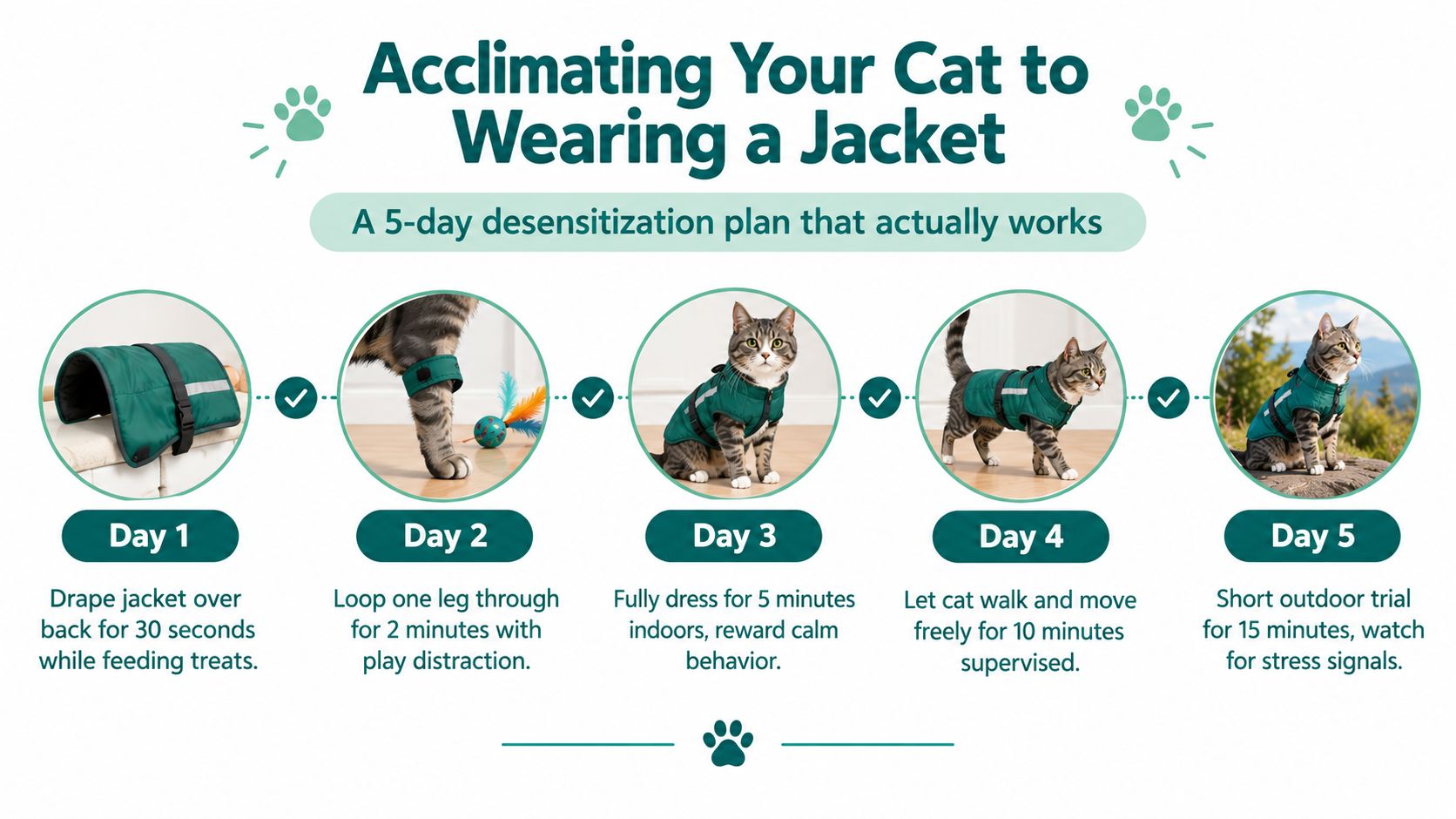
Most jacket failures happen because the owner skips acclimation. A carrier-training study found that cats trained to enter and accept their carriers showed less behavioral stress during a brief car ride and cooperated better during handling. The same principle applies here. Familiarity changes the experience, while forced exposure often teaches the cat to fear the garment.
A workable scenario starts with a calm adult cat that already accepts brief torso handling. On the first day, the owner places the jacket near the feeding area and rewards investigation. Once the cat remains relaxed, the jacket can be draped over the back for a short moment during feeding, then removed before the cat becomes uncomfortable.
On the second day, one leg can be guided through an opening for about two seconds. A treat should arrive within three seconds of calm behavior, followed by immediate release. On the third day, the chest strap can be secured briefly, still indoors and while the cat is eating or engaged in a favorite game.
Stop at the first meaningful stress signal
The first week should involve sessions lasting under ninety seconds, with no attempt to reach full wear until the cat voluntarily approaches the jacket. Play can help lower arousal after each session, but it shouldn't distract an overwhelmed cat while the owner forces the garment into place.
Stop immediately if the cat shows:
- A tucked tail or flattened ears
- Hissing, growling, or frantic escape attempts
- Freezing in place
- Repeated attempts to chew or claw the garment
- Hiding for more than two hours after removal
Short-haired adults may progress more easily than kittens or long-haired seniors, but individual temperament matters more than coat type. Some cats never accept clothing, even with careful conditioning. That isn't stubbornness. It's useful information.
A cat that needs transport training may also benefit from this step-by-step cat crate training guide. The jacket should never become a replacement for carrier conditioning.
<iframe width="100%" style="aspect-ratio: 16 / 9;" src="https://www.youtube.com/embed/KWQfL3JRwGM" frameborder="0" allow="autoplay; encrypted-media" allowfullscreen></iframe>When a Jacket Actually Helps Your Cat
A jacket earns its place when it solves a real problem without creating a larger one. Cold-sensitive cats, including hairless breeds and frail seniors, may benefit from added warmth during brief exposure to cold conditions. A shaved cat may need protection after a procedure, but the veterinary team should determine whether a jacket, recovery suit, or controlled indoor warmth is appropriate.
Travel is another possible use. A jacket with a harness connection can simplify leash loading or a short walk between a vehicle and a building, but only if the cat already walks comfortably on a leash. Putting a new harness-jacket on a frightened cat at a busy departure point is a reliable way to trigger an escape attempt.
An anxiety wrap may provide gentle pressure for some cats during a storm, vet visit, or journey. Evidence for individual benefit is limited, and pressure can make another cat feel trapped. It should be tested during a quiet indoor period, not introduced for the first time during a crisis.
A recovery suit can be more practical than a cone for some abdominal wounds, but it isn't general-purpose clothing. It must remain clean, dry, and easy to remove for inspection.
| Scenario | Jacket Helps? | Why |
|---|---|---|
| Hairless cat in cold weather | Often, if tolerated | Adds insulation during controlled exposure |
| Healthy indoor shorthair | Usually not | The garment adds complexity without a clear benefit |
| Leash-trained cat during loading | Sometimes | A harness connection can simplify short transfers |
| First-time use during a stressful trip | No | The cat has no chance to learn the garment safely |
| Post-surgical wound | Only with veterinary approval | Coverage may help, but fit and wound monitoring are critical |
| Warm indoor room | Usually not | Extra layers can cause heat stress |
A jacket won't resolve intercat aggression, separation anxiety, or fear of strangers. Those problems need environmental management and behavior support. Owners preparing a cat for a move should also address the wider transition with guidance such as how to acclimate cats to a new home, rather than expecting clothing to calm every source of stress.
Travel, Transport, and the Jacket Question
For a short veterinary appointment, the carrier matters more than the outfit. A familiar blanket, a stable carrier, and calm loading usually do more than dressing a cat in a new jacket. A garment may even complicate emergency removal if the cat becomes distressed.
For longer car rides, a jacket with a harness loop can help only during controlled transfers. The cat should already accept the garment, and the carrier should allow the cat to stand, sit, lie down, and turn around. It must also be well ventilated and secured so it can't slide during braking.
Air travel rarely gives a jacket a meaningful role because the cat remains in an approved carrier for the journey. Ground transport presents different demands. During longer journeys, the driver or handler needs a plan for monitoring, water, food, temperature, restraint, and elimination. A jacket addresses only one small part of that system.
Welfare controls matter more than mileage
Transport guidance recommends observing animals at least every four hours and managing food and water during those checks. It also states that vehicle confinement shouldn't exceed 14 hours without an overnight rest stop and an opportunity for exercise and elimination outside the vehicle, as detailed in this animal transport best-practices document.
Heat exposure is a serious preventable hazard. A cat must never be left unattended in a parked vehicle, even when climate control is running. For a ground move lasting more than a brief local trip, temperature monitoring and secure containment matter far more than whether the cat wears a coat.
A professional ground transport service can address the route-level problems a jacket can't solve, including door-to-door handling, welfare checks, and transport coordination. Owners comparing options can review this pet taxi guidance for cats when a long-distance move requires more planning than a routine car ride.
Quick Checklist and When to Skip It
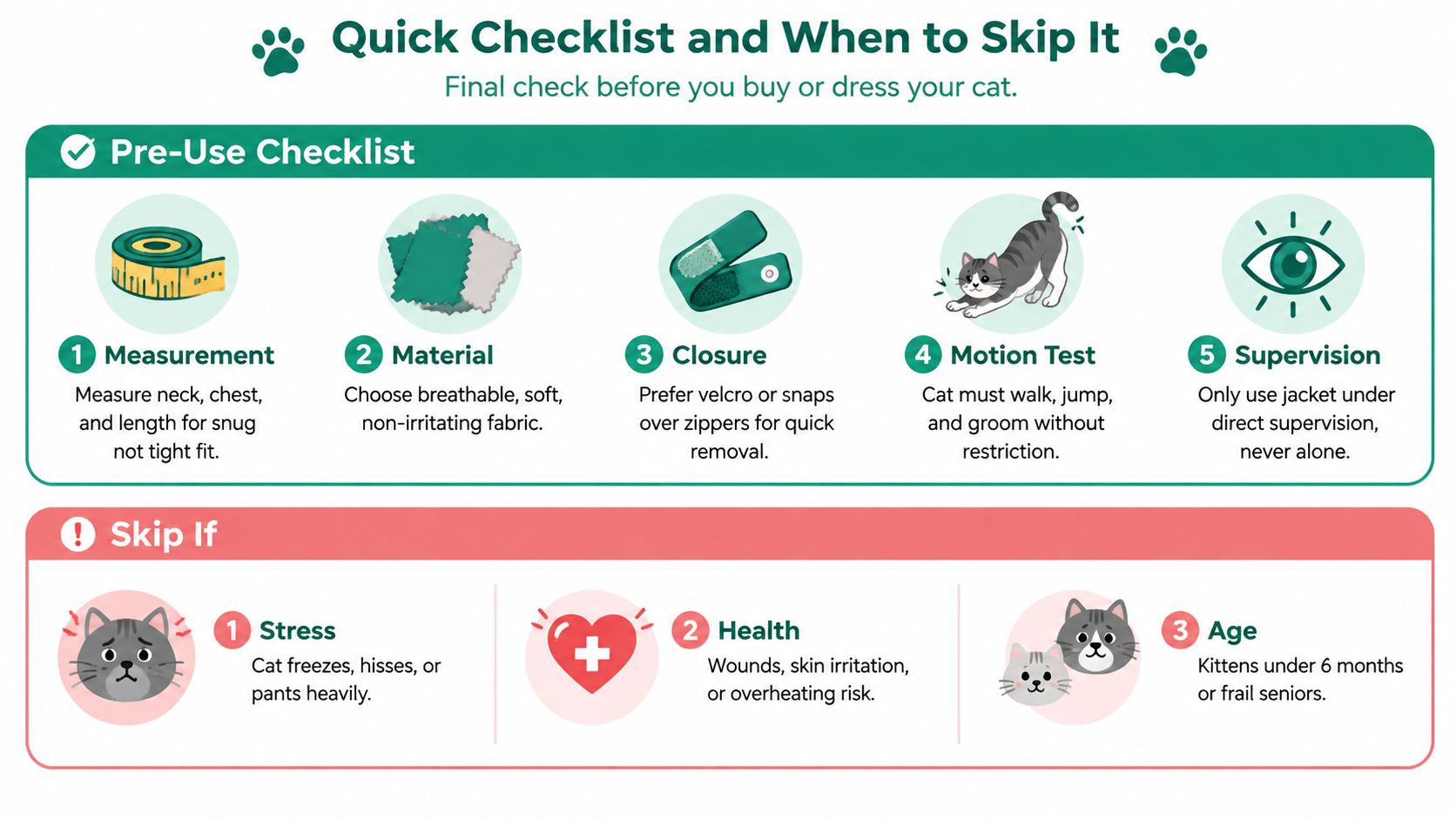
A jacket should pass a practical inspection before it reaches the cat. The garment needs the right measurements, soft construction, fast-release closures, and enough freedom for ordinary feline movement.
Pre-purchase and pre-use checklist
- Measure first: Record neck, chest, and back length, then compare them with the specific sizing chart.
- Choose gentle material: Look for breathable, soft fabric without rough seams or abrasive edges.
- Prefer quick removal: Velcro or snaps are easier to release than a complicated closure during distress.
- Test movement: The cat must walk, sit, jump, groom, and use the litter box without restriction.
- Inspect contact points: Check the armpits, neck, belly, and any harness attachment for rubbing or pressure.
- Supervise every wear session: A jacket shouldn't stay on an unattended cat, especially during the first trials.
Skip the jacket when the risk is obvious
Skip it temporarily if the cat needs more acclimation. Two calm sessions aren't enough to declare failure, but persistent freezing, hissing, heavy panting, escape behavior, or prolonged hiding means the training plan should stop.
Skip it entirely for kittens under four months, cats with active skin irritation, cats with unprotected surgical incisions unless a veterinarian approves the garment, and cats at risk of overheating. The infographic's broader caution about very young kittens and frail seniors reinforces the need to judge the individual cat rather than follow a fashion trend.
Strictly indoor cats in climate-controlled homes usually don't need jackets unless travel, recovery, or another specific need changes the situation. A jacket is a tool, not a requirement.
Decision rule: If a cat doesn't need functional protection or can't wear the jacket calmly and move freely, skip the jacket.
Ferried connects pet owners with verified independent drivers for door-to-door ground transport across the United States, with trip updates, secure payment handling, and pet protection included with each booking. For a cat whose transport needs involve distance, climate, and welfare planning rather than clothing alone, visit Ferried to review available ground transport options.
Ready to transport your pet?
Post your transport request for free. Verified drivers bid for your trip, you pick the best offer.
Get free quotes