Short Nosed Dogs Flying: Airline Risks Explained
In this article
- Table of Contents
- Why Short-Nosed Dogs Face Higher Flying Risks
- The Anatomy Behind the Breathing Problem
- Cabin Cargo or Ground How the Options Compare
- What Major Airlines Actually Allow in 2026
- A Pre-Booking Checklist for Brachycephalic Owners
- Why Ground Transport Works for Short-Nosed Dogs
- Choosing the Right Option for Your Dog
Roughly half of the 122 dog deaths associated with airline flights involved short-nosed breeds, so cargo is not a reasonable default for a pug, bulldog, or similar dog. Most major carriers now restrict or prohibit brachycephalic dogs in the cargo hold, while some may allow small dogs in the passenger cabin if they fit beneath the seat.
That figure comes from U.S. Department of Transportation flight-death statistics released in July 2010. Over the preceding five-year period, short-nosed breeds represented approximately one-half of the documented airline dog deaths, despite making up only a minority of pets transported by air. English bulldogs accounted for 25 of the 122 deaths, followed by pugs with 11, according to the AVMA's summary of air-travel risks for short-nosed dogs.
Those numbers explain why airlines refuse many bookings that look available online. For owners researching short nosed dogs flying, the practical question isn't whether a carrier accepts a breed. It's whether the dog can tolerate the specific combination of airway anatomy, airport handling, temperature, route complexity, and travel stress.
The safest domestic default is usually door-to-door ground transport. Cabin travel can work for a small dog that fits comfortably under the seat, but cargo should be treated as the least attractive option, even where a carrier technically permits it.
Table of Contents
- Why Short-Nosed Dogs Face Higher Flying Risks
- The Anatomy Behind the Breathing Problem
- Cabin Cargo or Ground How the Options Compare
- What Major Airlines Actually Allow in 2026
- A Pre-Booking Checklist for Brachycephalic Owners
- Why Ground Transport Works for Short-Nosed Dogs
- Choosing the Right Option for Your Dog
Why Short-Nosed Dogs Face Higher Flying Risks
Short-nosed dogs made up roughly half of the 122 dog deaths associated with airline flights, even though they represented only a minority of dogs transported by air. English bulldogs accounted for 25 deaths and pugs for 11 in the federal record, as summarized in the American Veterinary Medical Association's air-travel guidance.
That mortality gap changes the booking decision. Pugs, English bulldogs, French bulldogs, Boston terriers, boxers, mastiffs, Pekingese, Lhasa apsos, and Shih tzus can face greater danger when heat, stress, confinement, and difficult breathing occur together. French bulldogs deserve particular attention in current travel planning, but breed lists vary between airlines. A booking that appears available online can still be refused after staff assess the dog's muzzle, breathing, or overall condition.
The environment creates the crisis
A brachycephalic dog may cope well at home while having little reserve during travel. Heat increases panting. Fear raises respiratory effort. Airport transfers add noise, unfamiliar handling, waiting, and crate confinement. Those pressures can arrive at the same time, leaving less room for recovery.
Cargo carries the highest practical concern because the dog is separated from its owner and may not receive immediate attention if breathing becomes labored. Heat stress, respiratory compromise, and mortality risk are the reasons airlines increasingly restrict short-nosed breeds in the hold. The global airline response summarized by ZooVet Travel shows the broader pattern, with major carriers commonly limiting these dogs to the cabin when they meet size rules.
Practical rule: A cargo booking shown on a website does not prove that the dog will be accepted, or that cargo is a sensible choice.
Use a clear decision rule. If a small dog fits comfortably in an under-seat carrier and breathes at rest, cabin travel may be workable. If the dog is too large, has noisy breathing, tires easily, has previous airway trouble, or handles heat poorly, choose door-to-door ground transport instead of cargo. For breed-specific planning, consult this short-nosed dog transport resource. That choice keeps the dog with a handler, avoids the aircraft hold, and allows closer control of temperature, stops, and stress.
The Anatomy Behind the Breathing Problem
Brachycephalic means the dog has a shortened skull and compressed upper airway structures. The problem isn't only the visible flat face. Several internal features can restrict airflow, reduce cooling efficiency, and make strenuous breathing more difficult.
A long-nosed dog cools itself by pulling air through a longer nasal passage, where internal structures help regulate airflow and temperature. A short-nosed dog has something closer to a half-built radiator. The system can function under calm conditions, but it has less capacity when the dog is hot, frightened, excited, or breathing harder than usual.
Four structures matter
- Stenotic nares: Narrow nostrils force the dog to draw air through a smaller opening.
- Elongated soft palate: Extra tissue can obstruct the throat, especially during heavy breathing.
- Hypoplastic trachea: A narrower windpipe limits the amount of air moving toward the lungs.
- Everted laryngeal saccules: Tissue pulled into the airway can further reduce the available passage.
These problems can stack together. A dog doesn't need to be visibly ill for the anatomy to matter. Snoring, stertor, gagging, rapid fatigue, or recovery that takes too long after mild activity should be treated as warning signs, not charming breed traits.
Why flight magnifies the weakness
An aircraft cabin operates with lower oxygen partial pressure than conditions at ground level, and the transfer process can expose a dog to abrupt changes in noise, handling, and temperature. A cargo hold may also experience substantial temperature variation during a tarmac delay, while the dog remains confined and unable to regulate its surroundings.
Stress triggers panting, but panting is precisely where these dogs are least efficient. An unfamiliar crate can produce a cortisol response before takeoff, leaving the dog physiologically compromised before the aircraft even climbs. That's why veterinarians and airlines often evaluate the breed class and muzzle structure, not just whether an individual dog appears young or healthy.
Cabin Cargo or Ground How the Options Compare
The three transport choices should be judged using the same questions: Can the dog legally travel this way? Can it breathe comfortably? Who monitors the dog? What happens if the plan fails?
Cabin travel offers the closest supervision, but the under-seat requirement excludes many English and French bulldogs. Cargo offers speed and route availability only when the carrier accepts the dog, yet it places the animal in the environment most associated with the documented risk. Door-to-door ground transport removes aircraft pressure changes, airport handoffs, and cargo handling, though it takes longer and requires route planning.
| Option | Breed Eligibility | Stress & Health Risk | Cost Band | Failure Mode |
|---|---|---|---|---|
| Cabin | Small dogs that fit comfortably in an approved under-seat carrier | Lower than cargo because the owner can observe the dog, but cabin heat, stress, and confinement still matter | Variable, based on the airline and route | Gate refusal if the carrier or dog doesn't fit, or if breathing appears unsafe |
| Cargo | Many brachycephalic breeds are restricted or prohibited | Highest of the three because the dog faces cargo handling, temperature exposure, and limited direct supervision | Variable, with airline and handling charges | Booking rejection, seasonal embargo, missed connection, or respiratory distress |
| Ground transport | Generally accommodates short-nosed breeds and larger dogs | Lowest aviation-related risk because the vehicle can remain climate controlled and the dog stays with a handler | Variable, based on distance, timing, and vehicle arrangements | Road delay, rescheduling, or a medical issue during the journey |
Cabin is a narrow exception
A small pug or Boston terrier may qualify if the dog can remain comfortably inside the carrier beneath the seat. The dog must have enough room to breathe naturally, and the carrier must meet the specific airline's dimensions. Cabin approval doesn't erase respiratory risk. It removes the cargo hold and keeps the dog within reach of a human.
Cargo is the weak link
The Department of Transportation's pet-travel guidance notes that airlines may limit which animals they carry and that some carriers don't transport brachycephalic breeds because of breathing risks. Owners who need a broader comparison of vehicle-based alternatives can review these animal transport services, but the core recommendation remains straightforward: if the dog cannot travel safely in the cabin, ground transport deserves serious consideration before cargo.
What Major Airlines Actually Allow in 2026
Airlines refuse brachycephalic dogs most often in cargo, not automatically in the cabin. Route, aircraft, date, temperature, connection, and breed classification can change the answer. The AVMA's air-travel guidance notes that some airlines allow small short-nosed dogs in the passenger cabin when they fit beneath the seat, while other carriers avoid transporting them because of breathing concerns.
A general pet page is only a starting point. Ask the airline's pet desk to approve the exact dog, route, date, and travel method in writing.
| Airline | Cabin | Cargo | Breed Restrictions | Seasonal Embargo |
|---|---|---|---|---|
| Delta | May allow eligible small dogs in the cabin, subject to carrier rules | Brachycephalic cargo bookings may be refused | Confirm the exact breed and muzzle structure | Conditions can affect acceptance |
| United | Policies may exclude short-nosed dogs from available pet programs | Brachycephalic cargo bookings may be refused | Treat the breed as restricted until the route desk confirms otherwise | Check the travel date directly |
| American | Cabin travel depends on carrier fit and documentation | Cargo availability and breed acceptance require route confirmation | Veterinary documentation may be requested | Weather can change the decision |
| Lufthansa | Small dogs may be allowed in the cabin if they meet requirements | Year-round cargo-hold restrictions for brachycephalic dogs were introduced by 2020 | Breed and route review remains necessary | Seasonal limits can apply to other arrangements |
| ANA | Cabin and cargo rules depend on the route and pet program | Restrictions apply to brachycephalic animals | Verify the exact breed list | Seasonal or route-specific limits may apply |
| JAL | Availability depends on route and operating conditions | Restrictions apply to brachycephalic animals | Confirm classification before payment | Seasonal or route-specific limits may apply |
Policies can change after payment
A booking reference does not confirm pet acceptance. The airline may still require a separate pet reservation, document review, carrier inspection, or temperature clearance. A policy published in January may not govern summer travel.
For a small pug or Boston terrier that fits comfortably beneath the seat, cabin travel is the only flight option I would seriously consider. For an English bulldog, French bulldog, or larger pug that cannot fit, cargo approval is too uncertain to treat as a plan. Door-to-door ground transport becomes the practical default because it avoids airline acceptance and cargo-handling limits.
Mixed-breed labels create another trap. Staff may accept “mix” during an initial inquiry, then reject the dog after seeing its muzzle structure or reviewing veterinary paperwork. Describe the dog accurately from the first contact.
“Probably accepted” is not a transport plan. Get written confirmation for the exact route, date, dog, and travel method before paying.
A Pre-Booking Checklist for Brachycephalic Owners
The checklist below is a go or no-go gate, not a collection of optional tips. A single uncertain answer should stop the flight booking until the owner has a documented resolution.
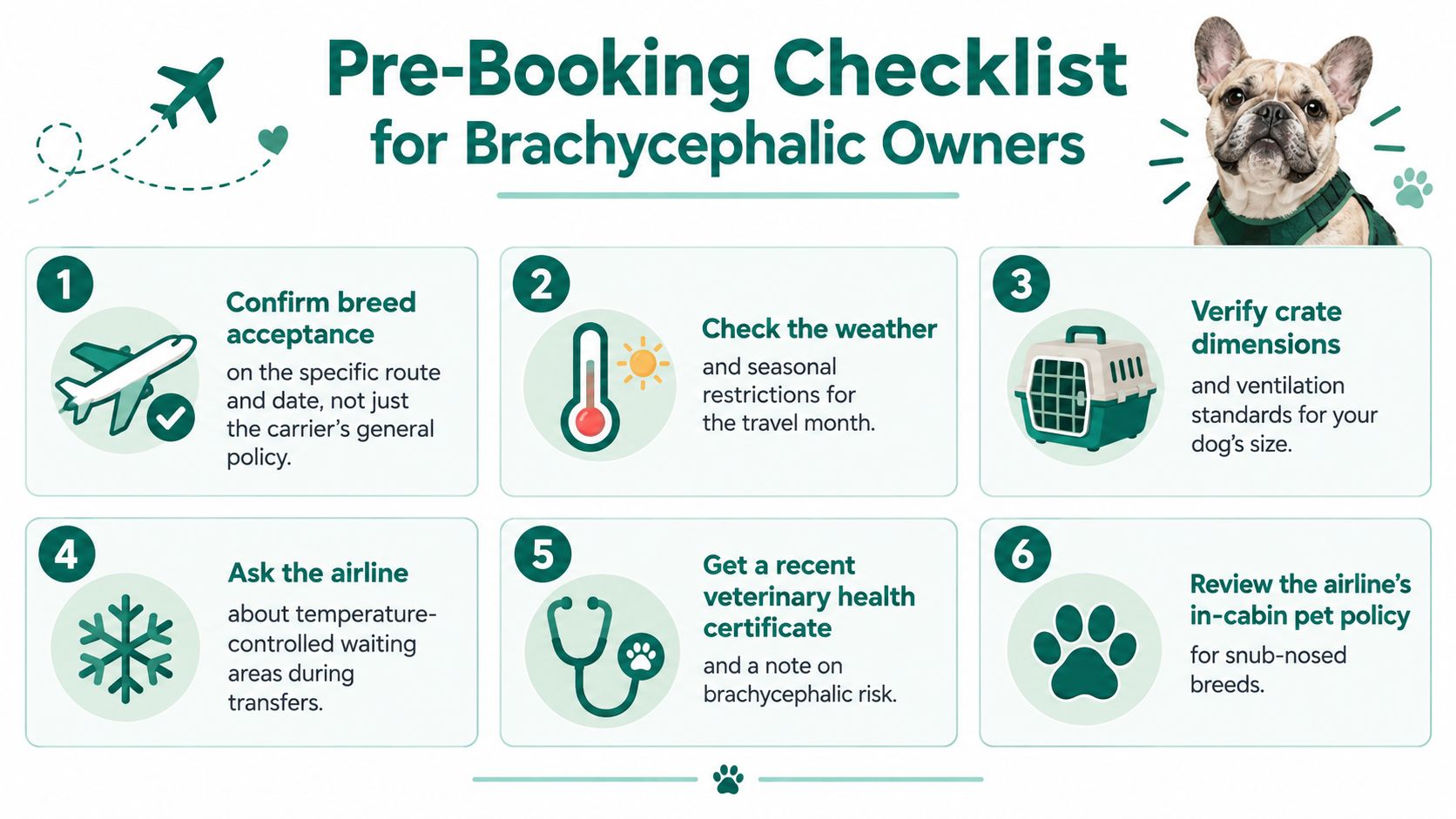
Start with acceptance
- Confirm the exact route and date. Ask the airline's pet desk whether the specific breed can travel on every flight segment. A carrier's general policy isn't sufficient.
- Review weather at every handling point. Check departure, destination, and connection airports. If the plan depends on mild conditions, it isn't a dependable plan.
- Measure and weigh the complete setup. The dog must fit comfortably in the approved carrier, not merely squeeze inside it. Include the carrier when the airline uses combined limits.
- Ask about transfer conditions. Confirm where the dog waits during connections and whether the area is temperature controlled. Don't assume “pressurized” means continuously comfortable on the ground.
- Schedule a veterinary assessment. Request a recent health certificate and a specific discussion of airway function, breathing sounds, heat tolerance, and travel fitness. A healthy-looking dog can still have serious airway limitations.
- Check cabin rules before considering cargo. If the dog is small enough for the cabin, verify carrier dimensions, under-seat placement, and pet-space availability before buying the human ticket.
The carrier should have strong ventilation, secure closures, and absorbent lining. Familiar bedding can reduce distress, but sedatives should never be used casually, particularly for a dog whose breathing is already compromised. Any medication decision belongs to the treating veterinarian.
If the airline won't confirm acceptance, the carrier fit is marginal, the weather is warm, or the veterinarian identifies respiratory concerns, the decision is ground transport instead of flying. That rule prevents an owner from turning a fragile booking into an airport emergency.
Why Ground Transport Works for Short-Nosed Dogs
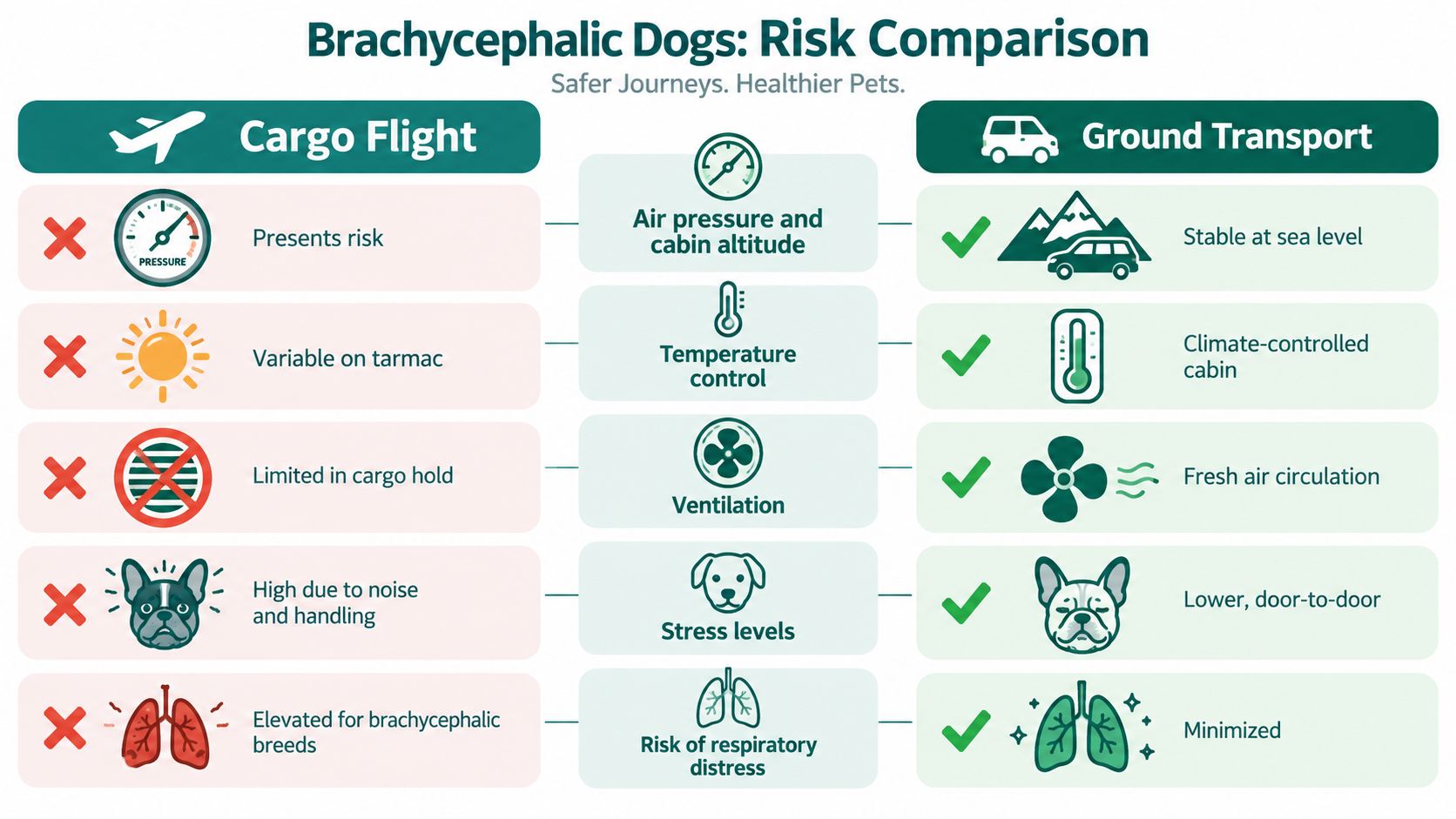
Door-to-door ground transport is the safest default for most domestic brachycephalic relocations because it removes the variables that make aviation difficult. A climate-controlled vehicle avoids aircraft pressure changes, eliminates cargo-hold loading, and allows the handler to monitor breathing, temperature, hydration, and behavior throughout the trip.
The dog stays in a familiar crate or travel setup rather than moving between the owner, airport staff, cargo handlers, and a destination pickup process. Planned stops can support water, bathroom needs, and observation. If the dog shows distress, the handler can respond immediately instead of waiting for the aircraft to land or for cargo staff to discover a problem.
The operational difference
Ground transport also avoids breed-specific airline embargoes. A large French bulldog, English bulldog, or mastiff may be too large for the cabin and unavailable for cargo, but vehicle transport can be organized around the animal's size and respiratory needs.
Ferried connects owners with verified independent drivers for door-to-door pet transport in the United States. Its marketplace model includes driver profiles, reviews, identity and background verification, trip check-ins, photo updates, and payment held until the owner confirms delivery. The service also includes pet protection on bookings and supports households moving multiple animals.
A practical route comparison
Consider a Boston terrier moving from Texas to New York. Airline cargo may be unavailable because of breed restrictions, and any remaining route would expose the dog to airport handoffs, temperature uncertainty, and limited supervision. Cabin travel could work only if the dog and carrier fit beneath the seat and if every segment accepts the pet.
A ground booking gives the owner a direct handoff to a driver, a climate-controlled vehicle, route visibility, and delivery to the new home. It may take longer than a flight, but it avoids the central physiological stressors that make cargo such a poor fit for short-nosed dogs.
Road travel isn't risk-free. Traffic, delays, illness, and poor handling can still create problems, which is why driver verification, clear communication, temperature control, and delivery confirmation matter. Owners comparing providers can use this guide to ground transport for dogs as a planning reference.
The better question isn't “Can this dog fly?” It's “What transport method gives this dog the most stable breathing environment from pickup to delivery?” For most domestic moves, that answer is ground transport.
Choosing the Right Option for Your Dog
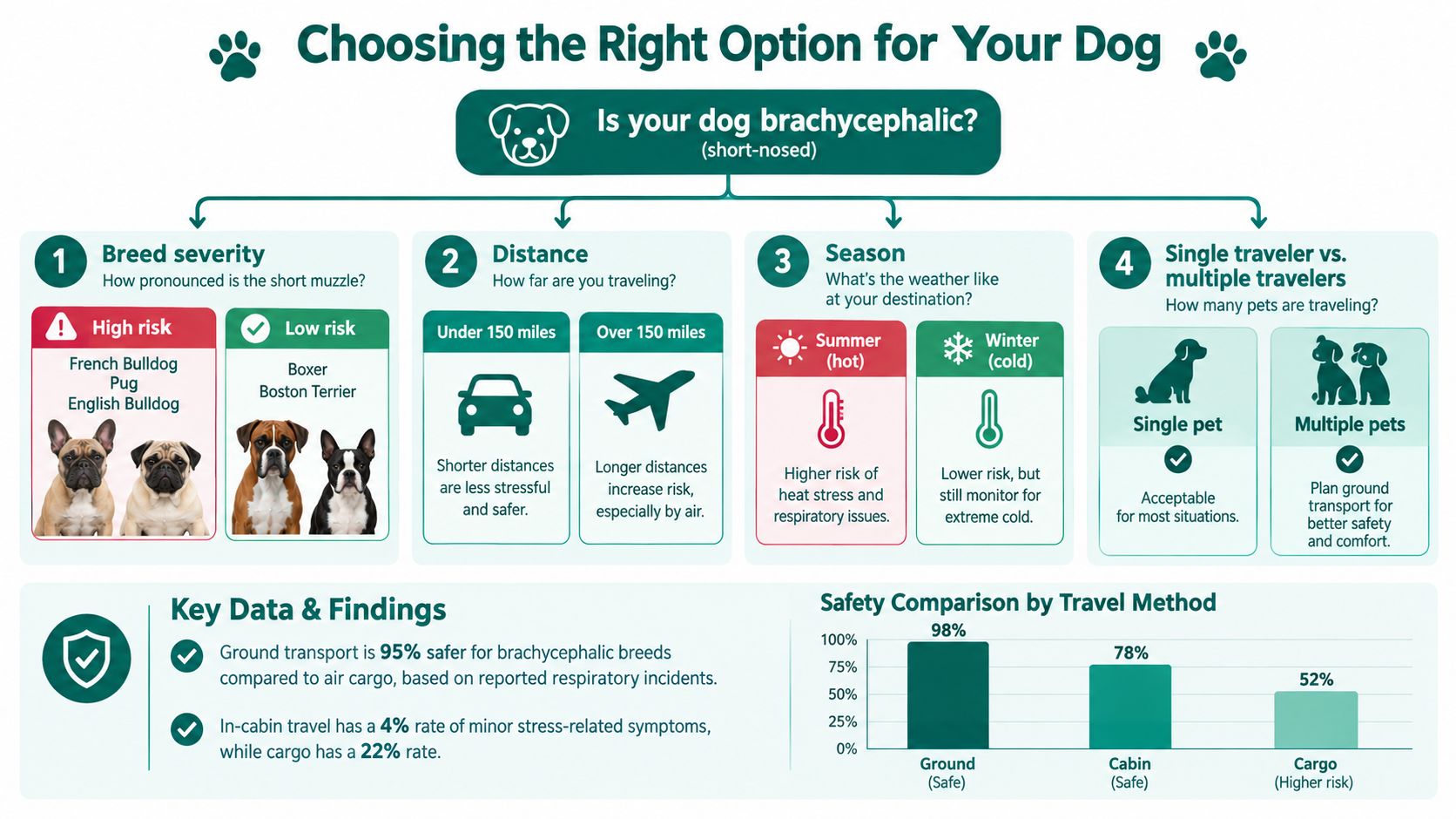
The decision comes down to four variables: airway severity, distance, season, and household logistics. Breed matters, but the individual dog's breathing history matters more. A quiet, comfortable Boston terrier isn't the same risk profile as an English bulldog that has already needed airway surgery.
Apply the four-variable rule
- Airway severity: French bulldogs, pugs, and English bulldogs deserve the strictest screening. Prior airway surgery, noisy resting breathing, fainting, exercise intolerance, or heat distress should push the decision toward ground transport or no travel.
- Distance: Short domestic routes rarely justify accepting cargo risk. A healthy adult French bulldog traveling from Boston to Washington, D.C., especially on a route that can be handled by vehicle, is a clear ground-transport case.
- Season: Warm weather increases the danger of airport waiting and vehicle loading. A Boston terrier moving from Ohio to Texas in July shouldn't be booked into cargo, regardless of whether an online form appears to accept the reservation.
- Travel party: One small dog may qualify for cabin travel if the airline confirms the carrier fit. Multiple pets, larger dogs, or animals with different care requirements are easier to manage through one coordinated ground booking.
Make the final call
Cabin travel is acceptable only when the dog fits comfortably, the airline confirms the exact itinerary, the veterinarian identifies no active concern, and the travel conditions are favorable. Cargo should not be the fallback because cabin space is unavailable. If the dog can't fit under the seat, the correct next step is ground transport, not a more aggressive cargo search.
An English bulldog with prior airway surgery should not fly without explicit veterinary direction, and many such dogs should avoid flying altogether. A pug with labored breathing should be assessed before any booking. A small, clinically comfortable dog with no respiratory history may qualify for the cabin, but the owner still needs a written airline confirmation and a contingency plan.
The simplest rule is this: if the route is under 500 miles, the weather is warm, or the dog has any respiratory history, choose ground transport over flying. If the veterinarian says no, the airline gives an uncertain answer, or the dog fails the carrier-fit test, the decision is already made.
Ferried offers door-to-door ground transport across the United States through verified independent drivers, with trip updates and payment held until confirmed delivery. Owners relocating a pug, bulldog, French bulldog, or another short-nosed dog can visit Ferried to request transport, compare driver profiles and bids, and plan a route without placing the dog in airline cargo.
Ready to transport your pet?
Post your transport request for free. Verified drivers bid for your trip, you pick the best offer.
Get free quotes