Two Dogs One Crate: Safe Setup and Transport Guide
In this article
Most advice on two dogs one crate treats a car ride like a nap at home. That's the wrong comparison. A quiet household crate doesn't move, brake, corner, shake, heat up, or force two animals into the same space when one becomes frightened. Transport changes the risk completely, so the default for most trips should be two properly secured crates, not one larger enclosure.
There are narrow exceptions. Very young, small, bonded dogs may sometimes share a crate when they're calm together in a moving vehicle, have no guarding history, and use an enclosure specifically sized and rated for both animals. Everyone else should travel separately, preferably in two crates placed side by side or in a properly engineered double crate with a divider.
Table of Contents
- Why Two Dogs in One Crate Is Usually a Bad Idea
- When Shared Crating Is Actually Defensible
- Sizing the Crate for One Dog or Two
- Loading and Securing the Setup in a Vehicle
- Shared Crate vs Two Crates vs a Double Crate
- A Real Relocation With Two Dogs
- Safe Transport Checklist and Bottom Line
Why Two Dogs in One Crate Is Usually a Bad Idea
Two dogs that sleep pressed together at home can still become unsafe companions on the road. This is a transport decision, not a household-training question. A vehicle adds vibration, engine noise, unfamiliar smells, sudden braking, sharp turns, motion sickness, temperature changes, and handling during stops. A dog that usually tolerates its companion may redirect fear or discomfort when neither animal can move away.
A panic stop turns that risk into force. One dog can be thrown into the other, while the crate absorbs the combined movement. A shared water bowl or resting spot can also become a conflict point. Ordinary single-dog crates should not be treated as equipment for two animals, because their structure and restraint system may not be designed for combined movement or impact (crash-tested crate safety guidance).
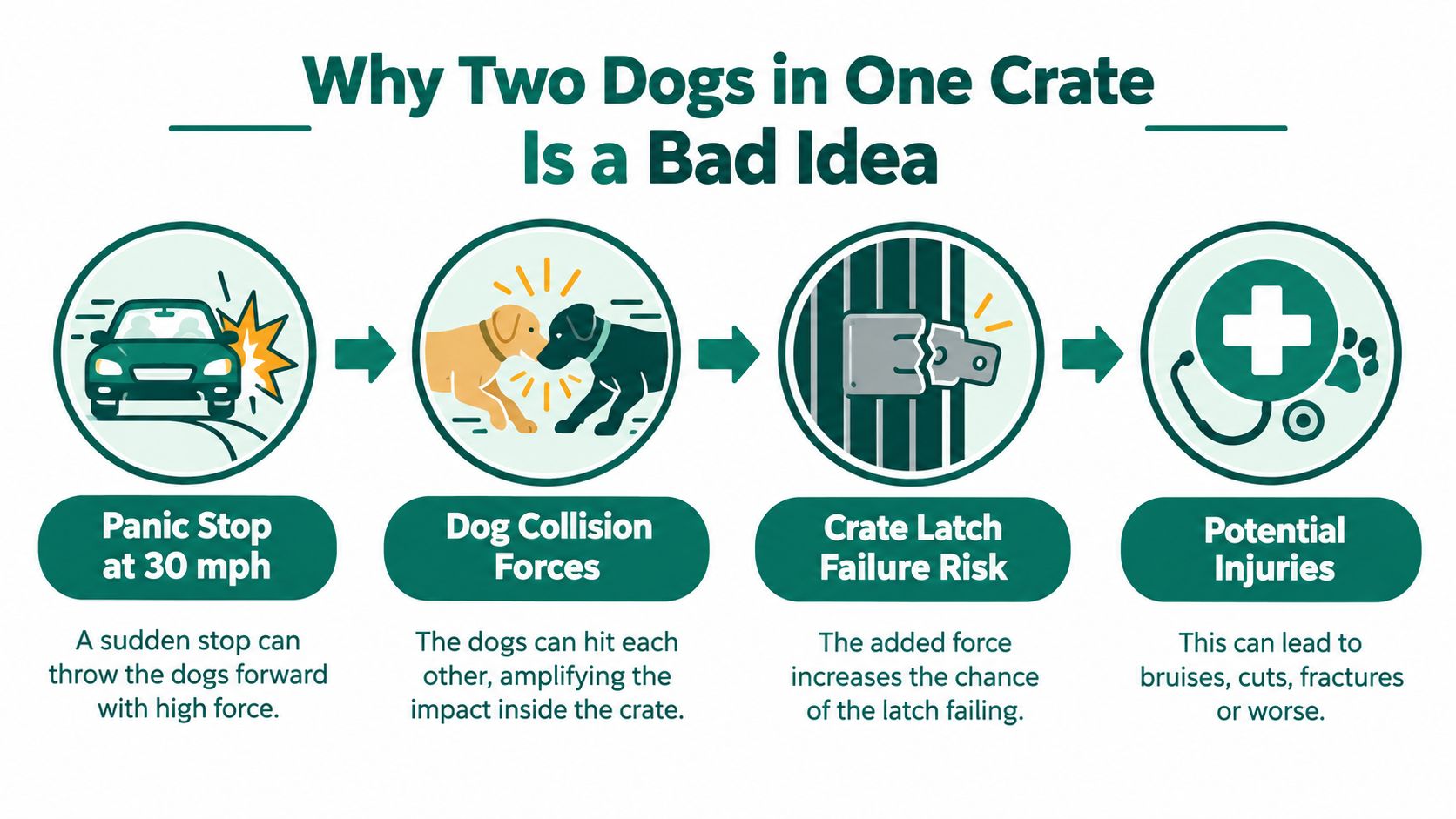
Three ways the setup fails
-
Redirected aggression: A sharp turn, sudden sound, or bout of nausea can trigger snapping toward the nearest dog. The companion becomes the only available target.
-
Compounded restraint forces: A latch or panel built for one animal may face greater movement and load when two dogs shift together. A crate rated for one large dog is not automatically suitable for two smaller dogs.
-
Excess heat and restricted airflow: Two bodies create a warmer, tighter space. If one dog pants heavily, both remain in the same air pocket, with no way to escape the heat.
The welfare test is stricter than asking whether the dogs like each other. ASPCApro limits shared crating to situations such as puppies, small dogs, bonded pairs, or littermates, and requires enough room for each dog to stand, turn freely, sit upright, stretch, and lie naturally (ASPCApro's loading and setup guidance).
Transport rule: Treat one crate for two dogs as a narrow exception, not a convenient default. For most road trips, two separate crates are the honest safer choice.
When Shared Crating Is Actually Defensible
Two dogs in one crate is a transport decision, not a household-training milestone. Shared crating is defensible only when every relevant condition passes. One failed condition means no-go. Use two separate crates instead, placed close enough for familiar scent and sound without forcing physical contact.
The narrow exception is a pair of small, adult dogs from the same household that has lived together peacefully for years. They should choose to rest together, show no food or toy guarding, and have stayed calm on previous drives. A test in a parked vehicle proves very little. Both dogs must handle engine noise, acceleration, cornering, traffic, and ordinary stops without escalating.
Keep the journey short and controlled. Plan water and bathroom breaks, and avoid treating a long relocation as a trial run. The crate must be built and sized for two dogs, not just large enough to contain them.
The binary decision
Use this checklist without exceptions. A single fail means separate containment.
| Condition | Pass | Fail |
|---|---|---|
| Relationship | Long-term bonded household pair | Newly introduced dogs or uncertain relationship |
| Behavior | No guarding over food, toys, water, or space | Any guarding, fights, snapping, or intimidation |
| Size | Both dogs are small and fit the dual-use enclosure correctly | Large dogs or a substantial size mismatch |
| Age and health | Similar adult dogs that travel comfortably | One senior, puppy, frail, injured, or motion-sick dog |
| Vehicle behavior | Both dogs remain calm during prior moving-car tests | Panic, persistent distress, vomiting, or agitation |
| Journey | Short, controlled trip with planned care stops | Long-distance relocation with limited flexibility |
| Equipment | Crate is engineered and rated for two dogs | Ordinary single-dog crate or improvised carrier |
| Air travel | Ground transport permits the setup | Airline rules require separate containers |
Breed and airway concerns make ground transport the more practical option for some dogs. Airline cargo policies commonly restrict snub-nosed breeds and call for oversized containers, including a container 10% larger than the standard minimum in some guidance (IATA guidance for transporting pets). That may rule out air travel, but it does not make shared crating safer.
For most ground carriers, two crates remain the safer standard. Choose shared crating only when the dogs, equipment, vehicle test, and journey all pass together.
Sizing the Crate for One Dog or Two
Crate sizing starts with posture, not the label on the box. For one dog, measure from the nose to the base of the tail for length. Measure height from the floor to the top of the head or ears while the dog sits. The interior must let the dog stand fully, turn without rubbing, sit upright, stretch, and lie naturally on its side.
The single-dog measurement
Use the interior dimensions, because thick walls, doors, corners, and hardware reduce usable space. A crate that appears roomy from outside may leave too little room inside.
Approve the fit only after checking four movements:
- Stand: The dog's back and ears stay clear of the roof.
- Turn: The dog pivots without wedging against either side.
- Sit: The dog sits upright without crouching.
- Lie: The dog stretches and settles in a natural position.
Run the same check with the dog wearing any travel harness or other equipment that will remain inside the enclosure.
The shared-crate calculation
For two dogs, measure each dog from nose to tail base and add the two lengths. That total is the practical minimum interior length for a shared enclosure when the dogs lie nose-to-tail. The height must suit the taller dog while sitting, and the width must allow both dogs to reposition without pressing one another into the sides.
This calculation proves physical fit only. It says nothing about whether the crate can manage the combined moving load. Two smaller dogs still shift weight together during braking, turns, and an impact, so a single-dog crate is not automatically suitable for dual occupancy.
Choose a crate with an explicit dual-use rating, vehicle-anchoring instructions, and adequate ventilation. Commercial crash-tested double crates are typically offered in wither-height tiers rather than one oversized universal model, including tiers for dogs up to 19.69 inches, 22.44 inches, and 24.02 inches at the withers. That distinction matters. “Double” describes a specific transport design, not just a large crate (vehicle-rated double-crate sizing reference).
If the manufacturer does not state that two dogs are permitted, treat the crate as single occupancy. For routine ground transport, two correctly fitted and separately secured crates remain the safer choice.
Loading and Securing the Setup in a Vehicle
A shared crate is only as safe as its vehicle setup. Park on level ground, clear the cargo area, inspect every door and latch, and place a non-slip mat beneath the crate. If the floor slopes, use stable wedges to level it. Do not let the enclosure rock during transit.
Have the crate open, positioned, and ready before either dog reaches the vehicle. Place the food lure inside, guide the first dog in calmly, close and latch the door, then handle the second dog. Load one dog at a time, starting with the larger dog. Keep the vehicle door closed until each dog is secured, and remove the leash only after the dog is safely inside, following ASPCApro's dog loading sequence. Keep the process quiet and controlled. Rushing creates escape opportunities and raises arousal.
A practical vehicle setup
Use two ratchet straps through the crate's upper and lower structural rails. Never run straps around unsupported wire mesh. Connect them to factory tie-down points, flatten twisted webbing, and tighten until the crate cannot shift. Add a rigid cargo barrier or cargo bar in front of the crate to limit forward movement during braking. The rear seat, a loose blanket, and the crate's own weight are not restraint systems.
Cover only part of the crate with a breathable blanket if passing sights trigger barking or agitation. Keep ventilation openings clear on every side that requires airflow, and never wrap the enclosure in fabric. Secure a water bowl where it cannot detach, and place absorbent pads on the floor for traction and spill control. Keep spare pads, gloves, cleaning bags, and other dog travel accessories within reach before departure.
Before starting the engine, test the installation by pushing and pulling the crate from several sides. Try to tip it. If it moves more than an inch, add an anchor or correct the positioning. Every latch deserves a second check. A shared crate must stay stable while both dogs shift their weight together.
<iframe width="100%" style="aspect-ratio: 16 / 9;" src="https://www.youtube.com/embed/6WuoM1ZKuCM" frameborder="0" allow="autoplay; encrypted-media" allowfullscreen></iframe>Limit direct animal contact during loading and cleaning. Wear disposable gloves when handling soiled bedding or bodily fluids. Cloth-covered bungee cords are not strong enough to restrain a loaded crate, so use proper ratchet straps and fixed tie-downs instead. If the crate cannot be anchored firmly, use two separate crates or change the vehicle setup.
Shared Crate vs Two Crates vs a Double Crate
The three configurations solve different problems. A shared crate uses the least floor space, but it also removes the dogs' ability to retreat from each other. Two separate crates take more room and create more loading work, yet they give each dog an independent boundary and make accidents, illness, or sudden anxiety easier to manage.
A double-rated crate with a removable divider sits between those choices. It needs to be engineered for dual occupancy, properly anchored, and large enough for both dogs when the divider is removed. The divider can preserve separation during travel, while the larger enclosure may be useful after arrival, provided the setup remains appropriate for the dogs.
| Factor | Shared Crate | Two Separate Crates | Double-Rated with Divider |
|---|---|---|---|
| Safety margin | Narrow, dependent on exceptional compatibility | Strong default for most pairs | Strong when correctly rated and secured |
| Cargo footprint | Smallest | Largest | Moderate to large |
| Cleaning | One shared mess affects both dogs | One dog can be cleaned without disturbing the other | Separate compartments simplify containment |
| Flexibility | Low | High | High, if the divider is secure |
| Best fit | Small, calm, bonded dogs with a proven travel history | Dogs of different temperaments, sizes, or health needs | Long-distance travel with a suitable vehicle |
| Main risk | Conflict, heat, and shared impact load | Space and weight requirements | Incorrect rating or weak divider |
Two separate crates also make it possible to transport one dog while the other receives care, rests elsewhere, or rides through nausea without being disturbed. A modular design can work well, but a removable divider only matters if it's locked securely and the entire unit is rated for the dogs' combined weight and movement.
For households arranging a relocation, rescue transfer, or family move, Ferried's multi-pet transport guidance can help frame the booking around each animal's containment needs rather than treating multiple pets as one cargo item. The practical recommendation remains simple: if there's room for two crates, use two crates.
A Real Relocation With Two Dogs
A 900-mile rescue transfer involved a four-year-old shepherd mix and a one-year-old hound foster. Both dogs were crate-trained separately, but they'd never traveled together in one enclosure. The handler chose a shared crate to preserve cargo space and expected the dogs to settle because they were individually comfortable in crates.
Within twenty minutes, the shepherd began guarding the water bowl. The hound responded with snapping, and the shared space gave neither dog a safe way to disengage. The handler had skipped a parallel-walk introduction, so the dogs had no structured opportunity to move together, observe one another's signals, and settle before confinement.
What should have happened first
A safer introduction would have used two handlers and two leashes:
- Start with the dogs far enough apart to remain loose and responsive.
- Walk in the same direction without forcing face-to-face contact.
- Close the distance gradually as both dogs stay calm.
- Practice stopping, turning, and standing near the vehicle.
- Run a short drive with separate crates before considering any shared enclosure.
That process would have exposed guarding, arousal, or motion sensitivity before the long route began. It also would have confirmed whether both dogs could remain calm in a moving vehicle, which matters more than how peacefully they sleep in a living room.
The handler pulled over at the next safe exit and moved the hound into a second crate secured with a ratchet strap in the passenger-side footwell. That position kept the hound separated from the shepherd and prevented the loose crate from becoming a projectile. The cargo area remained available for the shepherd's properly secured enclosure and supplies.
After arrival, both dogs needed a 72-hour decompression period before demanding introductions, busy outings, or close shared spaces. A new environment, a long drive, unfamiliar people, and accumulated fatigue can keep arousal high even after the vehicle stops. Separate feeding, rest areas, and controlled contact give each dog time to recover.
A second crate isn't paranoia. It's the boring safety net that lets a tired handler finish the drive.
Transport coordinators can find additional preparation guidance in Ferried's resource on how to prepare a dog for long-distance transport. The core lesson is operational: separate crates create options when behavior changes, while a shared crate turns one problem into a confined emergency.
Safe Transport Checklist and Bottom Line
Make the crate decision before booking or loading. Ground transport is the routine reality for many dogs, so the equipment and handling plan deserve serious attention. Save this checklist on the phone used for departure-day coordination.
Field checklist
-
Compatibility: Confirm that both dogs stay calm during handling and moving-car tests. Guarding, snapping, fighting, or escalating distress requires separate crates.
-
Sizing: Measure nose to tail base and wither to crown. Check interior dimensions, and confirm that each dog can stand, turn, sit, stretch, and lie naturally.
-
Configuration: Choose two separate crates unless the dogs meet every shared-crating condition and the enclosure is explicitly rated for two. A double-rated unit with a secure divider is the other defensible option.
-
Anchoring: Use factory tie-down points, structural rails, proper straps, a non-slip mat, and a forward barrier. Before departure, push, pull, and try to tip the enclosure.
-
Ventilation: Keep airflow open through the full setup. Avoid airtight covers, and monitor panting, posture, heat, and distress during planned stops.
-
Trial run: Test the exact dogs, crates, vehicle positions, bowls, bedding, and loading sequence before the trip. A calm household nap does not prove safe vehicle behavior.
Routine mistakes are predictable. Owners misjudge wither height, use a soft carrier for a long vehicle journey, skip a moving-car trial, leave a crate loose in the cargo area, or assume bonded dogs will share resources without conflict. Each mistake removes a safety margin that separate containment would provide.
A shared crate is defensible only for small, bonded, conflict-free dogs with proven calm vehicle behavior and a purpose-built dual-rated enclosure. Every other situation calls for two crates. That is the safer setup, and it is the arrangement many ground carriers use because it preserves separation if one dog becomes frightened, overheated, or reactive.
For a relocation where each dog needs a separate crate and careful handling, Ferried connects pet owners with verified independent drivers for door-to-door ground transport, including multi-pet bookings, trip updates, and payment protection through confirmed delivery. Submit route details at Ferried and compare transport options before moving day.
Ready to transport your pet?
Post your transport request for free. Verified drivers bid for your trip, you pick the best offer.
Get free quotes